Get a Video Gap Analysis for your company · See which videos could have the biggest pipeline impact
See Where Your Competitors Are Winning With Video Get a custom Video Gap Analysis for your company · See which videos could have the biggest pipeline impact
Thanks - our team will review your website and put together your personalized Video Gap Report. Expect it atthe email address you provided within 2 business days.
We'll put together a personalized report showing where video could have the biggest impact, how your competitors are using it, and specific opportunities for your team. You'll get strategic recommendations, not generic advice.
Thank you! Your submission has been received!
Oops! Something went wrong while submitting the form.
Customer Testimonial Template: 7 B2B Frameworks for Better Customer Stories
Seven B2B customer testimonial templates to capture stronger, more specific customer stories without making them sound scripted
September 16, 2026
You ask a happy customer for a testimonial.
They agree.
Then you get this: "Great company. Great team. Highly recommend."
Positive? Absolutely.
Useful to a buyer evaluating your company? Not especially.
The problem usually is not the customer. It is the prompt.
Asking someone to "give us a testimonial" gives them almost no direction about what information would actually make their story valuable.
A customer testimonial template solves that problem by giving the story a structure without telling the customer exactly what to say.
What Is a Customer Testimonial Template?
A customer testimonial template is a framework for organizing a customer's experience into a clear story. It typically helps uncover the customer's original problem, why they chose a product or service, what their experience was like, what changed, and why the result matters.
The important word is framework.
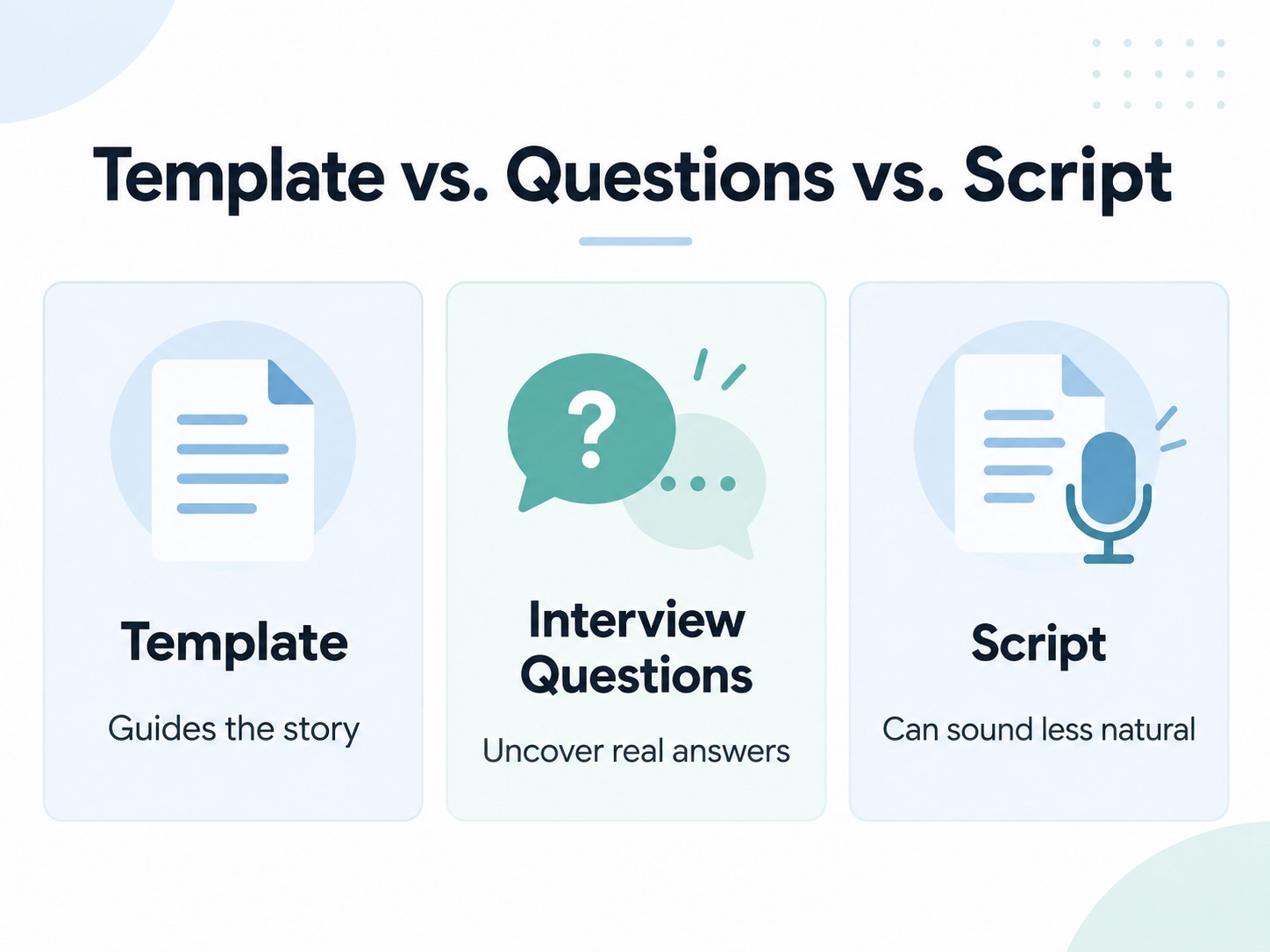
A good testimonial template should guide the story without scripting the customer's answer.
That distinction matters.
Customers rarely sound natural when they are handed polished marketing copy and asked to repeat it. The strongest testimonials come from real answers, specific experiences, and language the customer would actually use.
For B2B companies, that usually means combining a strong story structure with thoughtful video testimonial questions.
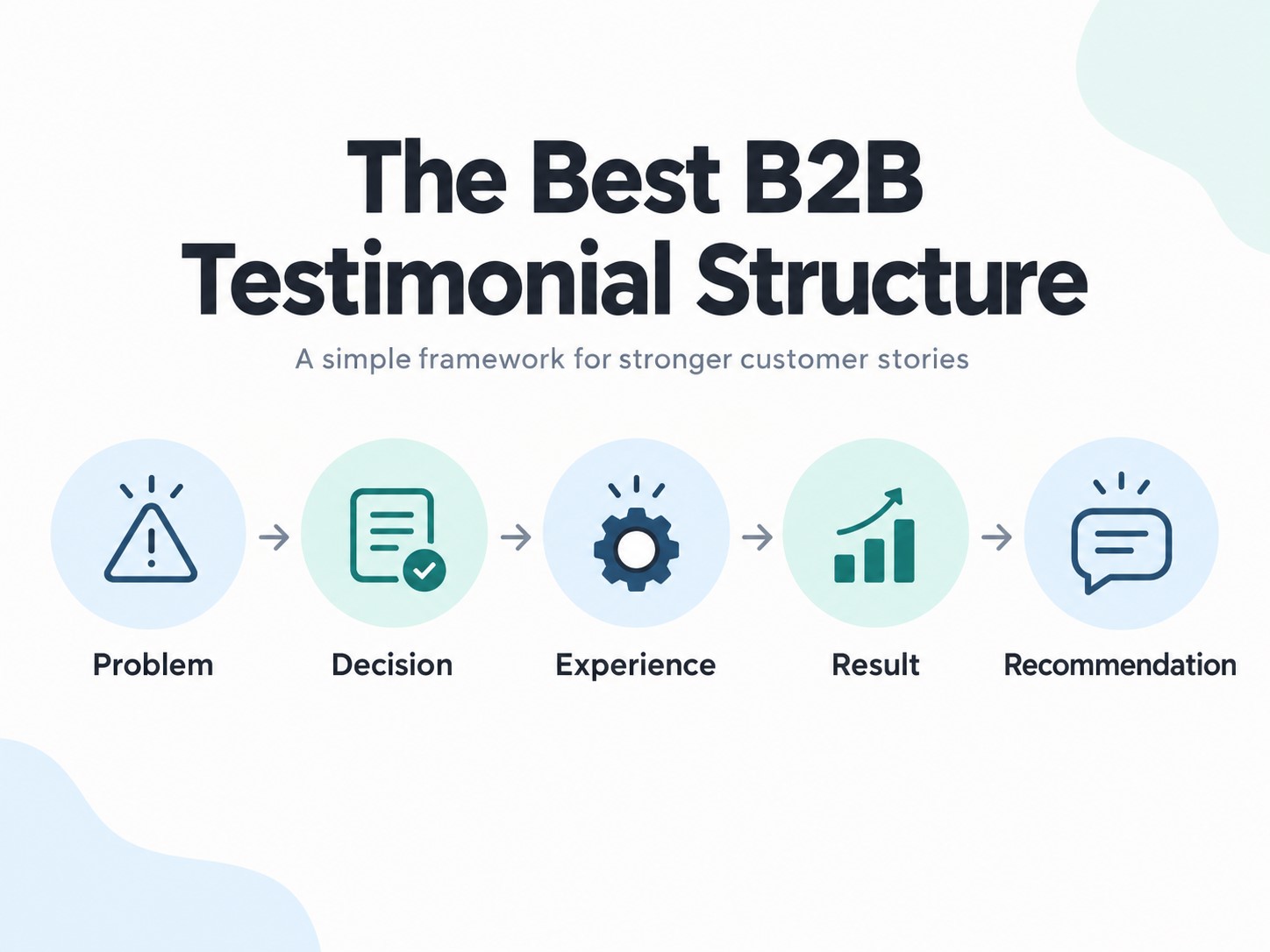
The Best B2B Testimonial Structure
If you need one customer testimonial template that works in most situations, start here:
Who is the customer?
What problem were they trying to solve?
What was difficult about the situation before?
Why did they choose your company, product, or service?
What was the experience like?
What changed as a result?
What would they tell another company considering the same solution?
In its simplest form, that becomes:
Problem -> Decision -> Experience -> Result -> Recommendation
That framework can support a short written quote, a two-minute testimonial video, a longer customer story, or a full case study.
The exact structure should change depending on the story you need to tell.
Here are seven useful B2B testimonial templates and when to use each.
1. The Problem-Solution-Result Testimonial Template
Best for: Most B2B customer testimonials
This is the most versatile testimonial framework because it follows the basic story a prospective buyer wants to understand:
Something was not working. The customer made a decision. Something improved.
Structure
Introduce the customer and their role.
Explain the problem they were dealing with.
Describe why the problem mattered.
Explain why they chose the solution.
Describe the experience of working with the company.
Share the result.
End with what they would tell another buyer.
Questions to Ask
What challenge were you trying to solve before working with us?
How was that problem affecting your team or business?
Why did you decide to work with us?
What was the experience like?
What has changed since?
What would you tell someone considering working with us?
Example
Imagine a software company helping a customer replace a manual reporting process.
A weak testimonial might say:
"The platform has been great and the team is very responsive."
A stronger story would explain:
"We were spending most of Monday pulling reports from three different systems. Now the team starts the week with everything in one place, which has given us hours back and made our forecasting meetings much more useful."
The second version gives buyers something they can recognize.
☑️ There is a problem.
☑️ There is a before-and-after change.
☑️ There is a business consequence.
That is what turns praise into proof.
2. The 60-Second Video Testimonial Template
Best for: Website videos, sales outreach, landing pages, social content, and short-form customer proof
Short testimonial videos need a tighter structure.
You do not have five minutes to explain the entire customer relationship. You need one clear problem, one meaningful outcome, and enough context for the viewer to understand why the story matters.
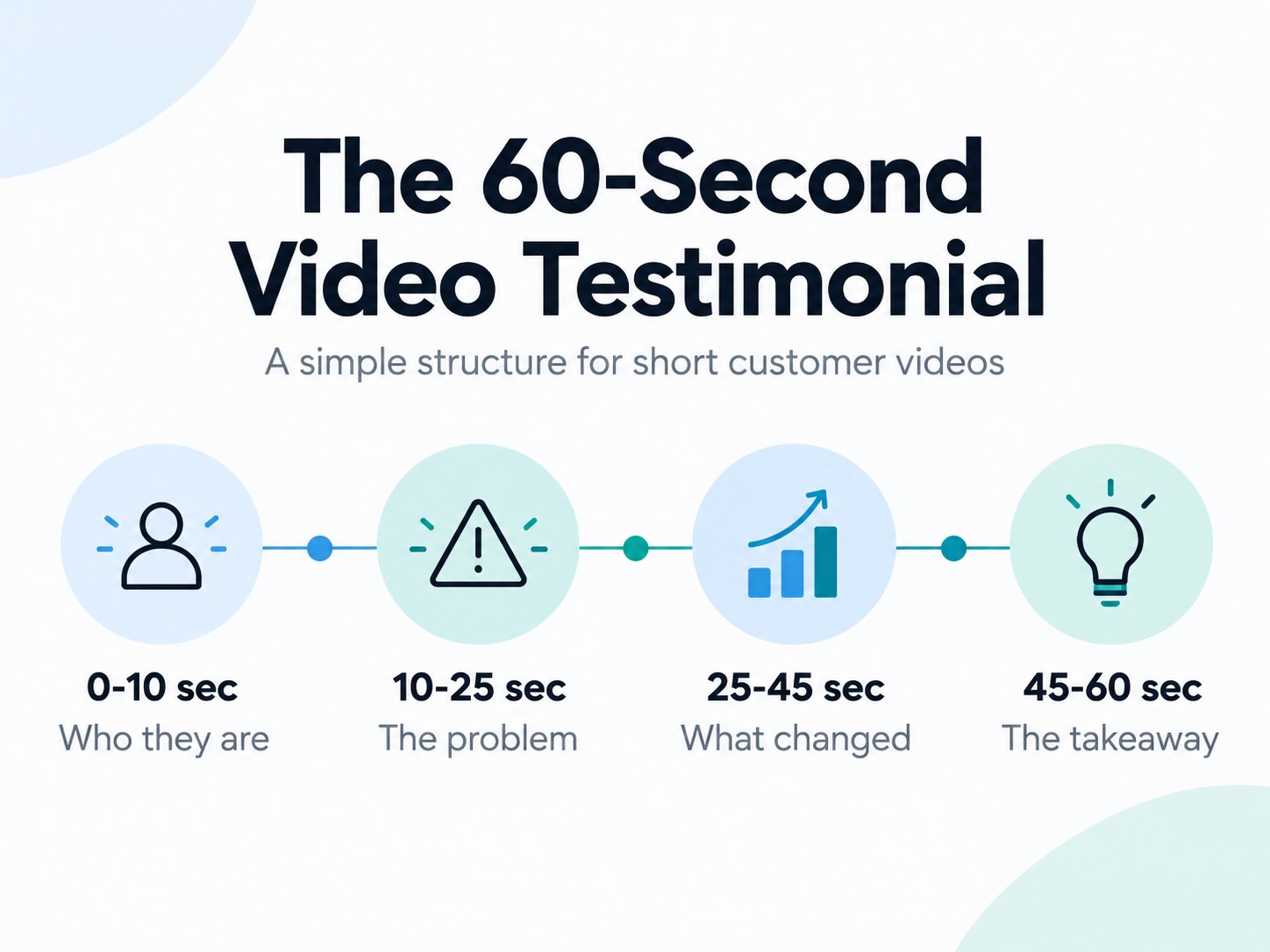
Structure
0-10 seconds: Who the customer is
10-25 seconds: The problem or need
25-45 seconds: What changed
45-60 seconds: The recommendation or takeaway
That does not mean the customer should record exactly 60 seconds of perfectly structured dialogue.
In a professionally produced testimonial, the interview itself will usually be longer. The final story is created during editing from the strongest parts of the conversation.
Questions to Ask
Tell us briefly about your role and company.
What was the biggest issue you needed to solve?
What changed after working with us?
What has been the biggest impact?
What would you tell someone considering the same solution?
If you are planning a longer customer interview, use a broader set of video testimonial questions and pull the short version from the full conversation.
That approach generally produces a more natural final video than asking someone to memorize a one-minute script.
The right finished length also depends on where the video will be used. This guide to testimonial video length breaks down how long different B2B customer videos should be.
3. The Results-First Testimonial Template
Best for: Customers with a strong measurable outcome
Sometimes the result is the story.
If a customer increased revenue, reduced costs, shortened a process, improved productivity, increased adoption, or achieved another clear result, do not bury that information at the end.
Lead with it.
Structure
Start with the strongest result.
Explain what was happening before.
Describe what changed.
Explain how the solution contributed.
Add context around why the result matters.
End with the broader business impact.
Questions to Ask
What result are you most proud of?
Can you quantify the change?
What did that number look like before?
What changed in the process?
Why does that result matter to the business?
Has the impact extended beyond the original goal?
Example
Instead of:
"We implemented the platform last year and have been really happy with it."
Try to uncover the story behind a statement such as:
"We cut our onboarding process from three weeks to nine days. That means our team can get new customers live faster without adding more implementation staff."
The percentage or number catches attention.
The context makes it meaningful.
That second part is important. A metric without context can still leave buyers wondering what actually changed.
4. The Buyer Decision Testimonial Template
Best for: Competitive markets, complex B2B purchases, and late-stage sales enablement
Some testimonials should focus less on what happened after the purchase and more on why the customer made the purchase in the first place.
These stories can be especially useful when prospects are comparing several vendors.
The goal is to uncover the customer's decision process.
Structure
Explain what the customer needed.
Describe what they were evaluating.
Identify the concerns or requirements that mattered most.
Explain why they chose this solution.
Describe whether the experience matched their expectations.
Share what they know now that they wish they knew then.
Questions to Ask
What were you looking for when you started evaluating options?
What mattered most in the decision?
Were you considering other approaches?
What made our company stand out?
Did you have any concerns before moving forward?
How did the actual experience compare with your expectations?
What would you tell someone currently evaluating their options?
This type of testimonial can answer questions a generic success story may miss.
A buyer does not only want to know whether a customer is happy.
They may want to know:
Why this option instead of another?
Was implementation as difficult as expected?
Was the investment worth it?
Would the customer make the same choice again?
Those are powerful questions for late-stage buyers.
They are also worth considering as part of a broader B2B case study strategy, especially if your existing customer library already contains plenty of general success stories but lacks content that addresses buyer objections and decision criteria.
5. The Implementation and Experience Testimonial Template
Best for: Services, complex products, enterprise software, or any purchase where implementation creates risk
A buyer may believe your product works and still hesitate because they are worried about what happens after signing the contract.
How difficult is onboarding?
How responsive is the team?
How much work will implementation create internally?
Will employees actually use it?
An experience-focused testimonial can address those concerns directly.
Structure
Explain the customer's expectations or concerns.
Describe onboarding or implementation.
Explain what working with the team was like.
Identify a moment that stood out.
Describe how quickly the customer began seeing value.
Share the longer-term impact.
Questions to Ask
What were you expecting the implementation process to be like?
Did you have any concerns before getting started?
What was onboarding actually like?
How did our team support you?
Was there a moment when you realized the solution was working?
What would you tell another customer worried about implementation?
This framework is especially valuable when the customer experience itself is part of what you sell.
A service company may not have a dashboard filled with usage metrics.
But a customer can still provide meaningful evidence about responsiveness, expertise, communication, speed, flexibility, or the amount of work removed from their own team.
6. The Executive Testimonial Template
Best for: Enterprise sales, leadership audiences, strategic services, and high-value customer stories
Executives often tell a different story than day-to-day users.
A user might focus on workflow.
An executive may care about:
Revenue
Cost
Risk
Scale
Productivity
Customer experience
Strategic flexibility
Speed to market
That means the interview should change with the spokesperson.
Structure
Establish the larger business priority.
Explain the risk or opportunity.
Describe why action was necessary.
Explain why the company chose the solution.
Share the strategic impact.
Connect the result to the broader organization.
Questions to Ask
What business priority were you trying to address?
Why was solving this important at that point in time?
What would have happened if nothing changed?
Why did you choose this approach?
What impact have you seen across the organization?
How has this affected your ability to achieve larger goals?
The strongest executive testimonials usually do not sound like product reviews.
They sound like business stories.
That makes them especially useful when the people approving a purchase are not the same people who will use the product every day.
7. The Testimonial Without Metrics Template
Best for: Customers who cannot share numbers or results publicly
A great customer story does not require a percentage.
Metrics are useful because they make outcomes concrete, but many B2B customers cannot publicly disclose:
Revenue changes
Cost savings
Internal performance data
Customer information
Operational benchmarks
Security data
Regulated information
That does not mean the testimonial has to become vague.
The goal is to replace unavailable numbers with specific qualitative evidence.
Structure
Explain the original situation.
Describe the specific problem.
Identify what changed operationally.
Give concrete before-and-after examples.
Explain what the team can now do that it could not do before.
Describe the broader effect on the business.
Questions to Ask
What was difficult before?
What does the process look like now?
What work has been eliminated or simplified?
What can your team do now that it could not do before?
How has the experience changed for employees or customers?
What would have happened if the problem had continued?
Instead of:
"It saved us a lot of time."
Try to uncover something like:
"Our operations team used to reconcile the data manually every Friday. That process is now automated, and the team only steps in when something needs attention."
There is no percentage.
There is still clear evidence of change.
If metrics are difficult to obtain in your industry, a case study without metrics can still provide credible proof when the interview gets specific enough.
Bonus: The Short Written Testimonial Template
Sometimes you do not need a full customer story.
You need three strong sentences for a landing page, proposal, sales deck, or testimonial page.
Use this structure:
The challenge
The meaningful change
The recommendation
For example:
"We were struggling to keep up with customer onboarding as our volume increased. The new process gave our team a much clearer workflow and eliminated a lot of the manual follow-up. I would recommend them to any team trying to scale without adding unnecessary complexity."
The same rule still applies:
Do not send that paragraph to a customer and tell them to read it.
Use the structure to identify the information you want to capture. Then let the customer's actual language shape the finished testimonial.
The point of a testimonial is not simply to show that someone likes your company.
It should give a prospective buyer evidence they can use while evaluating a decision.
That is becoming particularly important as B2B research moves across search engines, review sites, websites, sales conversations, and AI tools.
UserEvidence's 2025 Evidence Gap research found that B2B buyers place significant value on credible customer evidence, including named testimonials and verified customer proof.
That makes specificity important.
Compare:
"Excellent company to work with."
With:
"Our implementation team went from manually updating three systems to managing the entire workflow in one place."
The second statement tells the buyer what actually changed.
How Long Should a Customer Testimonial Be?
The right length depends on where the testimonial will be used.
A written testimonial may be one strong sentence.
A homepage quote may be 25 to 50 words.
A short social video may be under a minute.
A primary customer testimonial video may need several minutes to establish the problem, experience, and outcome.
A longer case study may include considerably more detail.
Instead of deciding that every testimonial should be the same length, start with its job.
Ask:
What does the buyer need to learn from this story?
Then make it long enough to answer that question without keeping material that does not add anything.
A customer testimonial template is a framework used to organize a customer's experience into a useful story. Most templates cover some combination of the customer's challenge, decision, experience, result, and recommendation.
What is the best structure for a testimonial?
For most B2B testimonials, a strong structure is Problem -> Decision -> Experience -> Result -> Recommendation. The exact format can change depending on whether the testimonial is focused on ROI, implementation, customer service, competitive differentiation, or another business outcome.
How do you write a customer testimonial?
Start by identifying the problem the customer faced, what they chose to do about it, what their experience was like, and what changed afterward. Whenever possible, include specific details or measurable outcomes rather than general praise.
Should customer testimonials be scripted?
Usually not. A testimonial framework and prepared interview questions can guide the customer toward useful topics while still allowing them to answer naturally. Word-for-word scripts often make testimonials feel less authentic.
What questions should you ask for a customer testimonial?
Start with open-ended questions about the customer's original problem, why they chose the solution, what the experience was like, what changed, and what they would tell another buyer. Follow-up questions are important for turning broad statements into specific examples.
Can a testimonial work without measurable results?
Yes. When customers cannot share metrics, focus on specific qualitative changes such as eliminated work, improved workflows, new capabilities, reduced complexity, better experiences, or concrete before-and-after examples.
What is the difference between a testimonial and a case study?
A testimonial usually provides a shorter statement or story about a customer's experience. A case study goes deeper into the customer's situation, challenge, solution, implementation, and results.
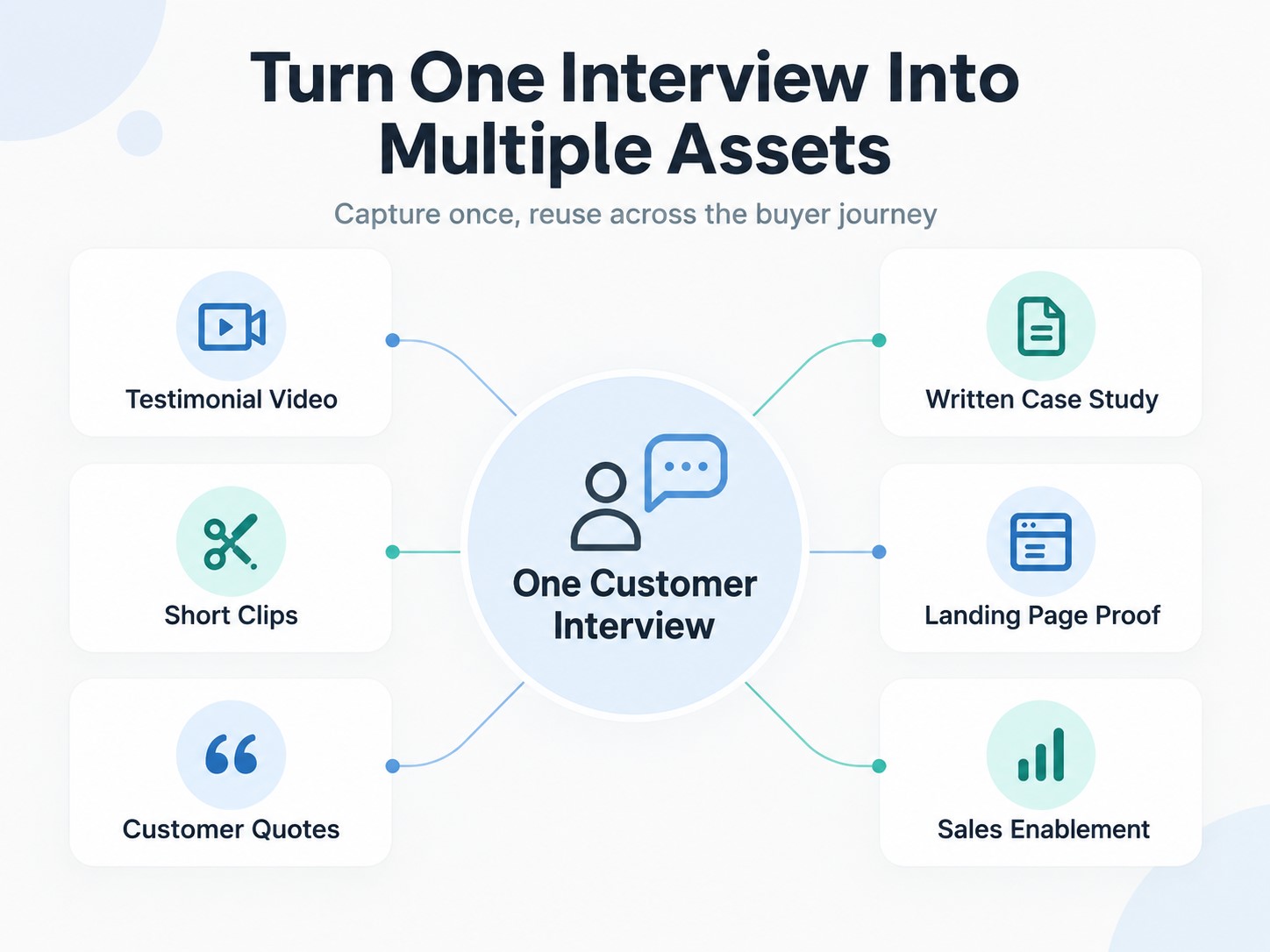
The same customer interview can often provide material for both. This video case study guide explains how to develop a fuller customer story.
A Template Should Make the Customer Story Better, Not Less Human
The purpose of a customer testimonial template is not to make every customer tell the same story.
It is to make sure the useful parts of their story do not get missed.
Start with the proof you need.
Choose the framework that fits.
Ask open-ended questions.
Listen for specifics.
Follow the interesting answers.
Then let the customer's real experience do the convincing.
CaseLeap helps B2B teams turn those customer experiences into testimonial videos and case studies built for marketing and sales. From customer interview planning through remote or on-site production, editing, and reusable content versions, the goal is to capture a real story once and make it useful across the buyer journey.
Turn the framework into customer proof. Talk to CaseLeap about your next customer story.
Build trust and accelerate conversions
Contact us today. We'd love to help you supercharge your sales conversions.