Get a Video Gap Analysis for your company · See which videos could have the biggest pipeline impact
See Where Your Competitors Are Winning With Video Get a custom Video Gap Analysis for your company · See which videos could have the biggest pipeline impact
Thanks - our team will review your website and put together your personalized Video Gap Report. Expect it atthe email address you provided within 2 business days.
We'll put together a personalized report showing where video could have the biggest impact, how your competitors are using it, and specific opportunities for your team. You'll get strategic recommendations, not generic advice.
Thank you! Your submission has been received!
Oops! Something went wrong while submitting the form.
B2B Case Study Strategy: Which Customer Stories Should You Create Next?
How to identify customer proof gaps and prioritize the stories your buyers and sales team actually need
September 2, 2026
You have 15 customer case studies.
Sales still asks, "Do we have anything for a company like this?"
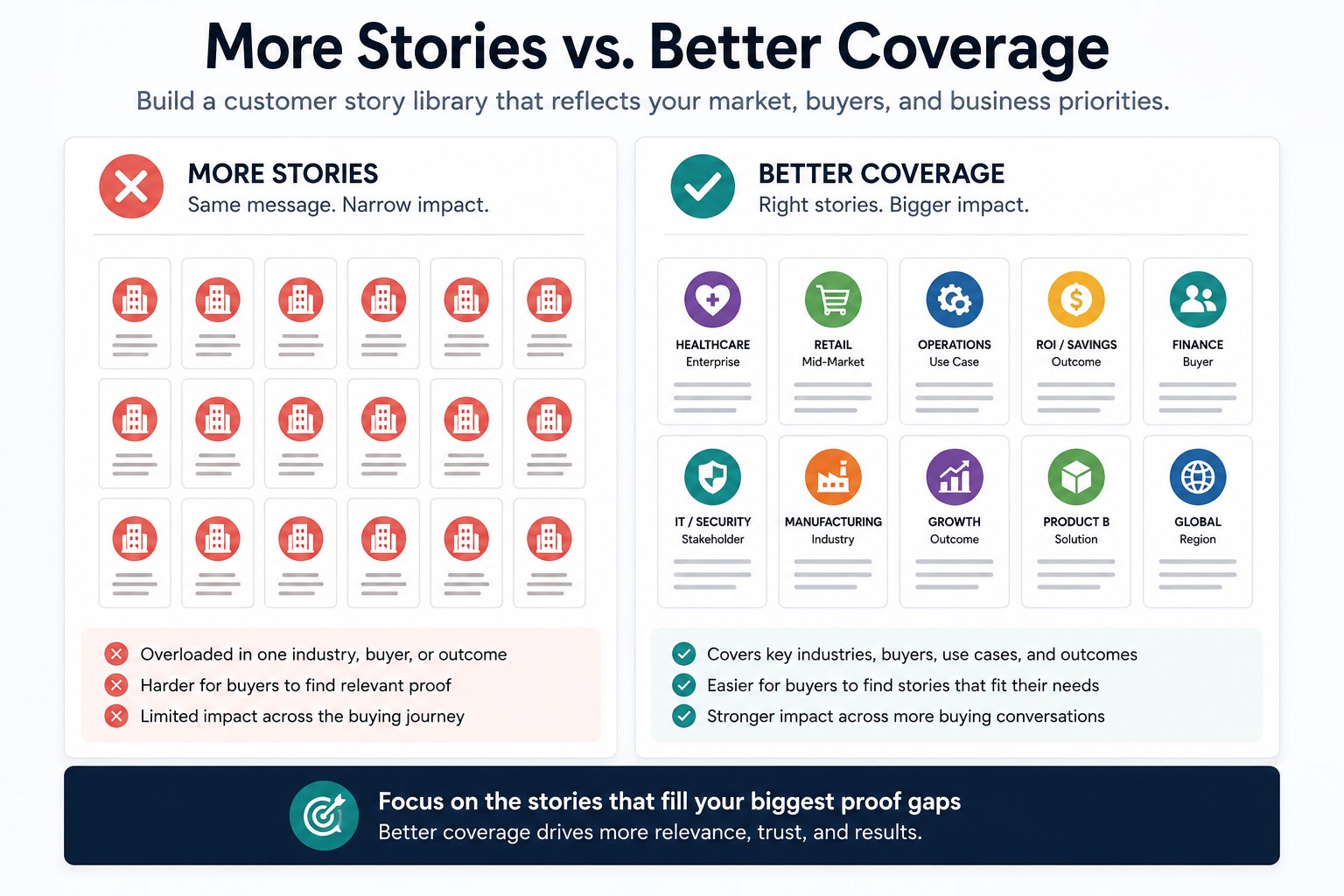
That usually means the problem is not the number of stories you have. It is the coverage.
A customer story library can look impressive while still leaving major gaps in the proof buyers actually need. You might have plenty of enterprise stories but almost nothing for mid-market prospects. Ten customers may talk about implementation, while none can show ROI. Or your strongest stories might all feature one product, industry, or buyer persona while your growth strategy has moved somewhere else.
A better B2B case study strategy starts by asking a different question:
Which customer stories are we missing?
A customer proof gap analysis helps you compare the stories you already have against the industries, buyers, products, use cases, challenges, and outcomes that matter most to your business. From there, you can prioritize the next stories based on actual sales and marketing needs instead of simply adding another logo to the library.
That is becoming more important as B2B buying gets more complicated. Forrester's 2026 research found that the average buying decision now involves 13 internal stakeholders and nine external participants, with even larger groups involved in complex purchases.
One customer story cannot answer every question those buyers bring to the table.
The goal is to build enough of the right customer proof that prospects can find evidence relevant to their situation.
What Is a Customer Proof Gap?
A customer proof gap is an important buyer question, market segment, use case, product, objection, or outcome that your current customer stories do not adequately support.
For example:
You sell heavily into healthcare, but nearly all of your public stories feature SaaS companies.
You target enterprise and mid-market buyers, but every recognizable customer is a large enterprise.
Your product promises to reduce costs, but none of your stories quantify savings.
Your sales team regularly encounters implementation concerns, but your case studies skip from purchase to results.
You recently launched a new product, but almost all of your proof still centers on the legacy offering.
Your customer stories speak to daily users, but provide little evidence for finance, IT, procurement, or executive stakeholders.
Your best stories are several years old and reflect products, positioning, or customer priorities that have since changed.
None of these problems are solved by deciding that the company needs "five new case studies this year."
They require knowing which five stories would make the biggest difference.
This distinction showed up clearly in our recent review of 30 leading B2B customer story programs. Twenty-three of the 30 companies offered meaningful ways to search, filter, or segment customer proof. Companies including Slack, Gong, Snowflake, Deel, and Figma let prospects narrow stories by dimensions such as industry, company size, use case, product, department, or region.
Those filters reveal something important about case study strategy.
If buyers need to sort customer proof by those dimensions, your story library needs enough coverage across those dimensions to make the filters useful in the first place.
Why Customer Proof Coverage Matters More in B2B
A B2B purchase is rarely being evaluated by one person with one set of concerns.
Forrester reports that 73% of purchases involve three or more departments. LinkedIn and Edelman's research also found that more than 40% of B2B deals stall because of buying-group misalignment, particularly when "hidden buyers" such as finance, operations, procurement, or legal influence a decision without being the primary product user.
That changes what useful customer proof looks like.
Your champion may need a story showing that the product is easy to use.
Their CFO may need evidence that the investment paid off.
IT may care about integration and implementation.
An executive sponsor may want proof that another company of similar scale trusted you.
Operations may care about adoption, productivity, or disruption to existing workflows.
The same generic success story may not satisfy all of them.
This is why a good sales enablement content library is organized around more than company logos. Sales teams need to be able to find proof by industry, buyer, use case, outcome, and objection when a specific question comes up in an active deal.
Your customer story strategy should be built around the same idea.
How to Run a B2B Customer Proof Gap Analysis
You do not need complicated software to find your biggest case study gaps.
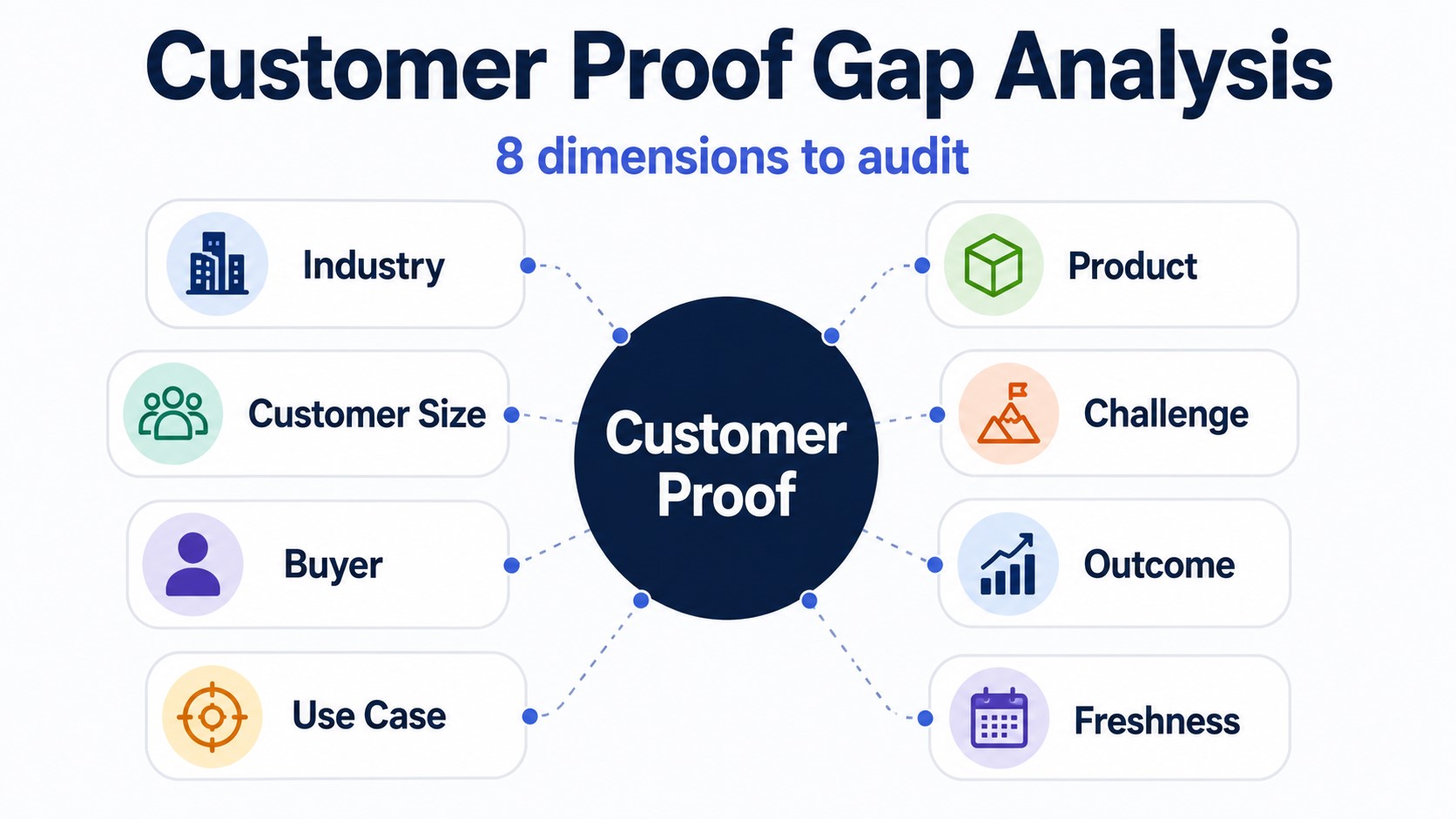
Start by listing your existing customer stories and reviewing them across eight dimensions.
The goal is not to make every box perfectly balanced. Some segments are more important than others.
You are looking for areas where a business priority and a proof shortage overlap.
1. Industry
Start with the industries your company actively targets.
Ask:
Which priority industries already have strong customer proof?
Which rely on one old or weak story?
Which have no customer story at all?
Are we overrepresented in industries that are no longer strategic?
Are there industries where specialized proof carries more weight because buyers have unique operational, technical, or regulatory concerns?
Industry relevance can dramatically change how useful a case study feels.
A healthcare technology buyer may want evidence involving clinical workflows, security, implementation, staff adoption, or compliance. A manufacturing buyer may care more about downtime, production efficiency, safety, labor, quality, or scalability.
That is why an industry-specific story can be more persuasive than a better-known customer from an unrelated market.
A mid-market buyer looking at a customer story from a Fortune 100 company may wonder whether the solution is too expensive, complex, or resource-intensive for their organization.
An enterprise buyer looking at a small-company success story may have the opposite concern:
Will this work at our scale?
If you sell across multiple company sizes, make sure your proof does too.
The goal is not necessarily equal representation. Weight your story coverage toward the segments responsible for the most revenue or future growth.
3. Buyer and Stakeholder
Who is actually represented in your customer stories?
Do most interviews feature marketing leaders? IT? Operations? Founders? Department heads?
Then compare that with the people involved in your real deals.
One helpful distinction is between champion proof and approval proof.
Champion proof helps the person who wants your product believe they are making a good decision.
Approval proof helps that person convince everyone else.
For example:
A department leader may describe how much easier a workflow became.
A CFO may speak to cost savings or ROI.
An IT leader may address implementation, integration, security, or reliability.
An executive may explain the broader strategic impact.
An everyday user may speak to adoption and usability.
You do not necessarily need a separate case study for every persona. In some cases, interviewing multiple stakeholders within the same organization can give one story far more range.
Our guide to creating a case study without metrics discusses this approach in more detail. Multiple perspectives can be especially valuable when no single headline metric carries the entire story.
4. Use Case
Map each customer story to the specific reason the customer bought.
Then compare those stories with the use cases driving your current pipeline.
You might discover that one use case represents a large share of new opportunities but appears in only one customer story.
That is a strong signal about what to capture next.
Ask your sales team:
Which use cases come up most often?
Which are hardest to prove?
Where do prospects ask for examples?
Which use cases are strategic growth areas?
Which stories are reps repeatedly sending?
This is one of the easiest ways to move case study planning closer to revenue.
One established product has years of customer stories behind it. A newer product has two.
Or the company sells six services, but the testimonial library makes it look like they sell one.
Look at your story library from the perspective of a prospect evaluating each individual offering.
If someone interested only in Product B visited your customer stories today, would they find credible evidence that Product B works?
If not, you have a proof gap.
6. Customer Challenge
Products are usually organized around what a company sells.
Buyers tend to think in terms of what they are trying to fix.
That makes the customer's original challenge another useful way to audit your stories.
Common challenges might include:
High costs
Slow processes
Manual work
Poor visibility
Low adoption
Scaling limitations
Complexity
Risk
Resource constraints
Customer experience problems
Implementation challenges
Look for repetition.
If eight case studies tell essentially the same story while a major buyer concern appears nowhere, your next customer interview probably should not produce story number nine.
This also affects the questions you ask during production. Strong customer testimonial questions uncover the specific problem, decision process, implementation experience, and business result instead of producing another round of "the team was great."
7. Outcome
This is one of the most important categories to audit.
What results does your product or service promise?
Then ask whether your customers are actually proving them.
Useful outcome categories might include:
Revenue generated
Cost savings
Time saved
Increased productivity
Faster implementation
Higher adoption
Reduced errors
Lower risk
Better customer experience
Increased retention
Faster growth
Improved visibility
Specific results make customer stories more useful because they give buyers something concrete to evaluate.
Recent StoryVoice research looked at 1,000 B2B software companies, with 954 usable sites. Among the 335 companies where researchers could inspect a readable customer story, 10.7% did not include a single measurable number in any sampled story.
StoryVoice is a customer proof software company, so we would treat the study as useful industry data rather than neutral academic research. But the underlying question is still worth asking:
Can buyers tell what actually changed for your customers?
Metrics are ideal when customers can approve them.
When they cannot, specificity becomes even more important. Concrete process changes, new capabilities, eliminated work, milestones, or before-and-after examples can still provide credible proof.
A case study without a percentage does not have to become a case study without evidence.
8. Freshness
Finally, look at age.
A strong customer story does not automatically become useless after a year. But stories can slowly lose relevance as:
Your product changes.
Your positioning changes.
Customer priorities change.
New competitors emerge.
Your target market changes.
The featured customer grows or changes.
The metrics become outdated.
StoryVoice found that among companies whose customer stories had verifiable dates, the median newest story was approximately 9.9 months old, and 44.2% had not published a new story in more than a year.
Again, there is no universal expiration date.
Instead, flag stories that no longer represent what you sell or what buyers care about.
Sometimes an older story needs to be replaced.
Sometimes it just needs an update.
And sometimes the smartest move is to return to a successful customer and capture the next chapter.
Turn the Audit Into a Customer Proof Matrix
Once you have reviewed those eight dimensions, put the information into a simple spreadsheet.
Create one row for every existing customer story and columns for:
Customer
Industry
Company size
Buyer or spokesperson
Use case
Product or service
Challenge
Outcome
Measurable result
Format
Publication date
Sales relevance
You can also add tags for common objections, funnel stage, geography, or whatever else matters to your business.
Then look across the complete library.
Patterns usually become obvious quickly.
Maybe you have plenty of enterprise SaaS stories but almost nothing supporting the mid-market segment you are trying to grow.
Maybe every story features marketing leaders even though operations has become an important buyer.
Maybe you have six implementation stories but nothing showing long-term ROI.
Maybe customers repeatedly talk about time savings, but none of your existing interviews produced an approved number.
Those are more useful insights than simply knowing you currently have 22 case studies.
Not Every Gap Deserves a New Case Study
Once you identify the gaps, resist the temptation to fill all of them.
A customer proof gap matters only if closing it helps achieve an actual business goal.
Prioritize each opportunity based on:
Revenue importance
Frequency in active sales opportunities
Strategic growth priorities
Sales team demand
Strength of the current proof
Availability of a strong customer
Difficulty of production
Ability to reuse the story across multiple needs
A simple three-tier system works well.
Tier 1: Critical Proof Gaps
These support important revenue segments, products, or buyer concerns where you currently have little or no credible evidence.
Fill these first.
Tier 2: Coverage Gaps
You have something, but it is old, weak, overly generic, or not especially relevant.
These become the next priority.
Tier 3: Expansion Opportunities
You already have sufficient proof, but another story would add variety, depth, or a recognizable logo.
These can wait until the first two categories are covered.
This prevents customer story production from turning into a logo-collection exercise.
A smaller customer with an unusually relevant use case and a strong measurable result may be much more useful than a famous brand repeating a story you already have.
Sometimes the Customer Story You Need Already Exists
Before asking another customer to participate, audit the raw material you already have.
One customer interview may contain enough information to produce:
A full testimonial video
A written case study
A 30-second ROI clip
An implementation-focused cut
A customer quote
A sales deck slide
A social post
A product-specific clip
An industry-specific story
A short objection-handling asset
This is one reason we recommend planning customer interviews around the broader proof library instead of treating each video as an isolated deliverable.
CaseLeap's testimonial video production services are structured around this approach: identify the buyer objections and proof gaps first, then shape the interview around the material marketing and sales actually need.
If the right customer is difficult to schedule for an on-site production, a professionally produced remote video testimonial can also make it easier to fill specific industry, persona, or product gaps without adding travel to every project.
For higher-value flagship stories where the environment, product, team, or process adds meaningful proof, on-site testimonial production can capture that context visually.
The format should follow the story and the business need.
Build Customer Story Capture Into Your Advocacy Program
Instead of starting from zero every time marketing needs a case study, maintain a pool of potential advocates and track information such as:
Industry
Role
Product
Results
Relationship strength
Willingness to participate
Past advocacy activity
Approval requirements
When the proof-gap audit identifies "we need a mid-market healthcare customer who can talk about implementation," you have somewhere to look.
That makes customer story production much more deliberate.
Your advocacy program identifies strong candidates.
Your proof-gap analysis identifies which stories are worth prioritizing.
Your production process turns those stories into assets sales and marketing can actually use.
How Often Should You Audit Your Customer Stories?
For most B2B companies, a lightweight review once or twice a year is enough.
Run one more frequently if your company is changing quickly.
Good triggers include:
A new product launch
A move into a new industry
A change in ICP
A major repositioning
A new sales motion
A shift from SMB to enterprise or vice versa
A website or resource center redesign
Repeated requests from sales for proof you cannot provide
And pay attention to one sentence in particular:
"Do we have a case study for...?"
If sales keeps asking the same version of that question, the answer may belong on your next customer story production calendar.
How Many B2B Case Studies Do You Actually Need?
There is no universal number.
Ten strategically chosen customer stories can be more useful than 50 repetitive ones.
The better benchmark is whether your library provides enough proof across the situations that matter to your buyers.
Ask:
Can our priority industries find relevant examples?
Can our most important buyers see someone like themselves?
Can prospects find proof for our primary products and use cases?
Can we address the objections that regularly slow deals down?
Can buyers see specific evidence of the outcomes we promise?
Can sales quickly find a relevant story when they need one?
If the answer is yes, adding another case study may not be the highest-priority investment.
If the answer is no, you now know where to look.
Frequently Asked Questions
What Is a B2B Case Study Strategy?
A B2B case study strategy is a plan for identifying, capturing, organizing, and using customer stories based on the evidence buyers and sales teams need. Instead of producing case studies opportunistically, the strategy prioritizes stories by industry, buyer, product, use case, challenge, outcome, and business value.
How Do You Choose Customers for a Case Study?
Start with customers who have achieved a meaningful result and can explain what changed. Then evaluate how well each customer fills a gap in your existing proof. Consider their industry, company size, role, product usage, use case, results, relevance to current sales opportunities, and willingness to participate.
There is no ideal number. The right number depends on the complexity of your market. A business selling one service to one type of buyer may need relatively few. A company serving several industries, company sizes, products, and use cases will need broader coverage. Measure whether important buyer questions have credible proof rather than aiming for an arbitrary number.
What Should a Good B2B Case Study Include?
A strong case study should explain who the customer is, what problem they were facing, why they chose the solution, what the experience was like, what changed, and why the result matters. Specific measurable outcomes are valuable when available, but detailed qualitative evidence can also create a credible story.
Written case studies give buyers detail, make specific results easy to scan, and create searchable content. Video adds the customer's actual voice, expression, personality, and environment, which can make the proof feel more credible and human.
The strongest format depends on the story and where you plan to use it. If video is part of the plan, you can compare remote vs. on-site testimonial production based on budget, logistics, production value, and use case.
Start With the Proof You Are Missing
Producing more customer stories can be valuable.
Producing the right customer stories is much more valuable.
Before planning the next batch, audit the proof you already have. Map it against your priority industries, customer sizes, buyers, use cases, products, challenges, and outcomes.
Then look for the gaps that overlap with actual revenue opportunities.
Those are the stories worth pursuing first.
CaseLeap helps B2B teams turn customer experiences into written case studies and testimonial videos built around the proof buyers actually need. From customer selection and interview planning through remote or on-site production and final deliverables, the goal is to make each customer story useful well beyond a single page on your website.