Get a Video Gap Analysis for your company · See which videos could have the biggest pipeline impact
See Where Your Competitors Are Winning With Video Get a custom Video Gap Analysis for your company · See which videos could have the biggest pipeline impact
Thanks - our team will review your website and put together your personalized Video Gap Report. Expect it atthe email address you provided within 2 business days.
We'll put together a personalized report showing where video could have the biggest impact, how your competitors are using it, and specific opportunities for your team. You'll get strategic recommendations, not generic advice.
Thank you! Your submission has been received!
Oops! Something went wrong while submitting the form.
Case Study Without Metrics? How to Show Real Results on Video
Your customer cannot share revenue, ROI, or performance numbers. Here is how to create a credible video case study without relying on vague praise.
August 6, 2026
You found the right customer. They have a strong story, they are willing to participate, and they are happy with the results.
There is only one problem.
They cannot share the numbers.
Maybe revenue data is confidential. Legal will not approve a percentage. The company does not publicly discuss internal performance. Or the results are real, but no one captured a reliable baseline before the project started.
Does that mean you should abandon the customer story?
Not necessarily.
Metrics make a case study stronger because they give buyers a concrete way to understand the impact. But a case study without metrics can still be credible, useful, and persuasive when it replaces vague praise with specific evidence.
That applies to both written case studies and customer testimonial videos.
In fact, video gives you additional ways to demonstrate change through the customer's voice, expression, environment, workflow, and real examples. The key is knowing what to ask and how to show proof without inventing numbers the customer cannot approve.
Can You Create a Strong Case Study Without Metrics?
Yes, but the story still needs evidence.
A customer saying your company was "great to work with" may be a nice testimonial. It is not a complete case study.
A case study needs to show a meaningful change:
What was happening before?
What was getting in the customer's way?
Why did they choose your company?
What changed after implementation?
How does the customer know the solution worked?
What can the customer do now that they could not do before?
A hard number is one way to answer those questions. It is not the only way.
When exact metrics are unavailable, focus on making the customer's experience concrete, observable, and relevant to the next buyer.
Why Customers May Not Share Case Study Metrics
A customer may decline to share results for several legitimate reasons.
The Data Is Confidential
Revenue, costs, production volume, conversion rates, customer counts, and internal efficiency data may be considered competitively sensitive.
This is especially common in enterprise, healthcare, financial, manufacturing, and technology organizations.
Legal or Communications Will Not Approve the Claim
Your direct contact may be comfortable discussing results, while another department controls what can be said publicly.
Even a verified number may be rejected because the company does not want to establish a public performance claim.
The Result Cannot Be Attributed to One Solution
Most business outcomes have multiple contributing factors.
A customer may know your product or service helped, but they may not be comfortable attributing an entire revenue increase, cost reduction, or performance improvement to one partner.
No Baseline Was Recorded
The improvement may be obvious to the team, but no one documented the original process well enough to calculate a clean before-and-after result.
The Engagement Is Still New
The customer may already see promising changes, but it is too early to publish long-term results.
The Customer Can Share the Experience, Not the Data
Some customers are allowed to discuss their process, satisfaction, implementation, or business impact but cannot disclose the underlying numbers.
Before giving up on metrics completely, ask what level of detail the customer can approve.
They may reject an exact figure but allow:
A range
A relative comparison
A general time frame
A directional result
A before-and-after process description
A nonfinancial result
An anonymized or aggregated figure
Never round, estimate, or imply a number without the customer's approval.
Replace Missing Metrics With Specific Proof
The biggest risk in a case study without numbers is becoming vague.
Statements such as these do not provide much usable proof:
"It saved us time."
"The process is better."
"The team is more efficient."
"We had a great experience."
"The product made a big difference."
The interviewer needs to go one level deeper.
Instead of asking only, "Did the solution save time?" ask:
What took the most time before?
What does that process look like now?
Which steps were removed?
Who was responsible for the work?
What can that person focus on now?
Can you describe a recent example?
When did you first notice the difference?
A strong case study without metrics does not eliminate proof. It changes the type of proof being collected.
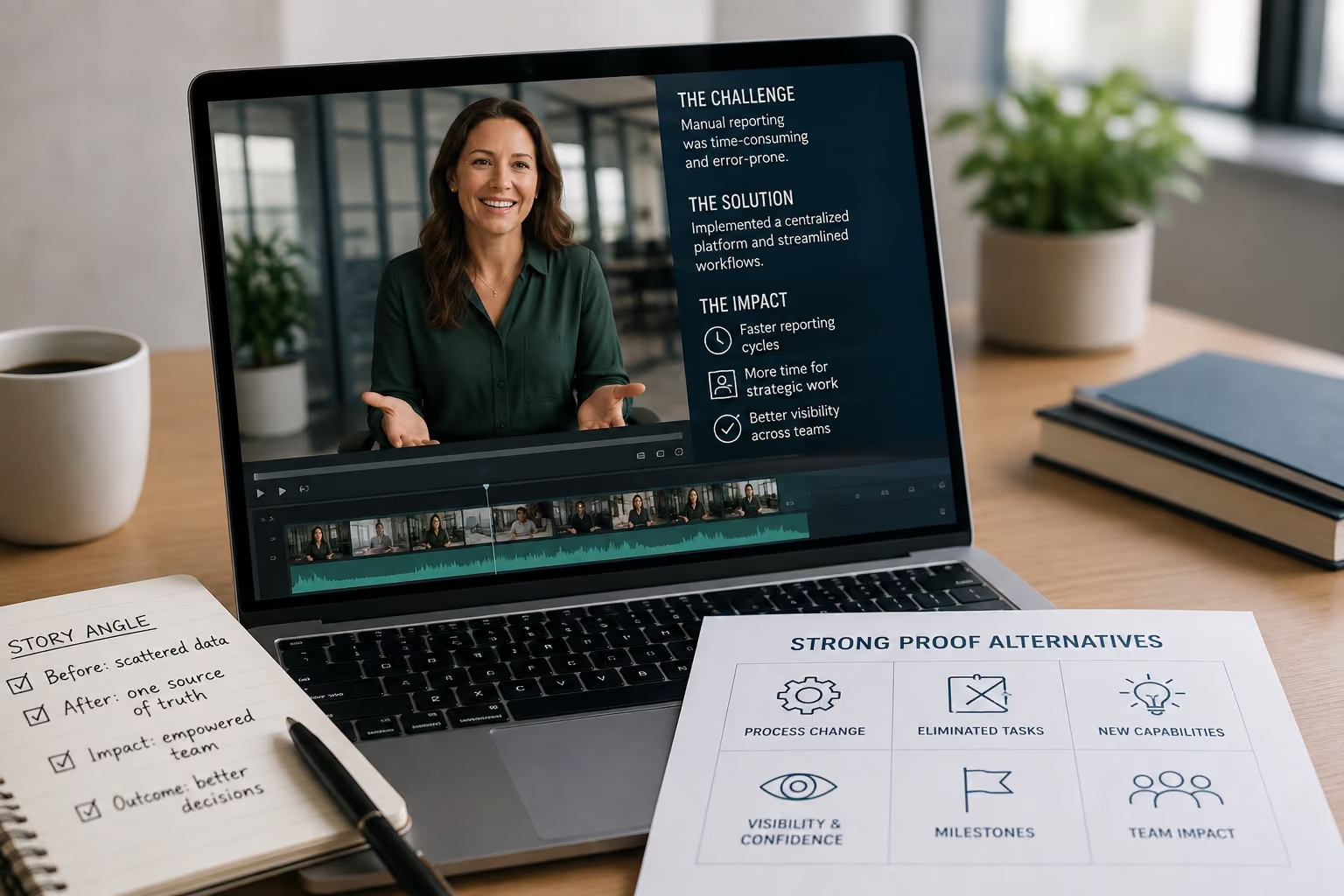
1. Show the Before-and-After Process
A clear process transformation can be persuasive even without a percentage attached.
For example:
Before:
"Every regional team maintained its own spreadsheet, so leadership had to request updates individually and reconcile conflicting information."
After:
"Now the entire organization works from the same dashboard, and leadership can view the current status without chasing down separate reports."
This communicates a meaningful operational change without claiming a specific number of hours saved.
For a video case study, the customer can explain the old process in their own words while supporting footage shows the new system in use.
2. Describe What the Customer No Longer Has to Do
Eliminated work can be just as meaningful as improved performance.
Ask the customer what they stopped doing after adopting the product or service.
Examples might include:
Manually combining reports
Re-entering information in multiple systems
Following up repeatedly for approvals
Searching through separate files
Rebuilding the same content for every campaign
Troubleshooting recurring technical problems
Coordinating several vendors
Checking work line by line
Creating temporary workarounds
A customer explaining, "We no longer have to spend Monday morning rebuilding the report," gives the viewer a clear picture of the improvement even if the customer cannot disclose the exact hours involved.
3. Focus on What Became Possible
Some of the strongest results are new capabilities rather than improvements to an existing metric.
Ask:
What can your team do now that it could not do before?
What project were you finally able to launch?
Which customers can you now support?
What decisions can you make with more confidence?
What information is now available?
What opportunity would have been difficult to pursue before?
What did this allow your team to prioritize?
This shifts the story from generic satisfaction to business impact.
For example:
"Before the implementation, we could only review performance after the campaign ended. Now our team can identify problems while the campaign is still running and adjust the strategy."
No confidential numbers are required, but the value is easy to understand.
4. Capture Speed Without Publishing Exact Numbers
A customer may not approve a precise result but may still be able to describe a clear change in speed.
Instead of forcing an exact percentage, explore language such as:
The same day instead of waiting for the next reporting cycle
During the meeting instead of after it
Earlier in the planning process
Before an issue reaches the customer
Without waiting for another department
In one workflow instead of several separate steps
Fast enough to respond while the opportunity is still active
These comparisons are more credible when the customer explains the real situation around them.
"Faster" alone is weak.
"We can answer the client's question while we are still on the call" is specific.
5. Show Improvements in Visibility and Confidence
Not every important business result appears on a revenue report.
A product or service may help a customer gain:
Better visibility
More consistent processes
Stronger internal alignment
Greater confidence in decisions
Clearer ownership
Fewer surprises
Better communication
More reliable information
A smoother customer experience
Less stress for the team
These outcomes can sound soft when stated without context. The interviewer's job is to connect them to a real business situation.
Instead of:
"We have more visibility."
Try to uncover:
"Before, we usually found out a project was behind schedule during the weekly status meeting. Now the project lead can see the issue as soon as it develops and address it before it affects the launch."
That is a specific result, even without a percentage.
6. Use Milestones as Evidence
A milestone can show progress without exposing confidential performance data.
Potential milestones include:
Completing an implementation
Consolidating multiple tools
Launching a new service
Expanding into a new market
Standardizing a process
Passing an audit
Meeting a deadline
Supporting a larger team
Introducing a new customer experience
Replacing a temporary workaround
Moving from a pilot to a broader rollout
Ask what the milestone meant to the customer and why it had been difficult to reach before.
The milestone should connect to the original challenge rather than appearing as an unrelated accomplishment.
7. Document the Human Impact
Business purchases affect people, not only dashboards.
A customer story can show how the solution changed the daily experience of employees, customers, patients, members, partners, or other stakeholders.
Ask:
How did the old process affect the team?
What was the most frustrating part?
How has the team's day-to-day experience changed?
What feedback have employees or customers shared?
What do people notice first?
What creates less stress now?
How has the working relationship changed?
What does the team have more time or energy to focus on?
Video is especially valuable here because viewers can hear the customer's tone and see how they react when describing the change.
A genuine moment of relief, pride, or enthusiasm can add credibility that a written claim alone may not carry.
The emotion still needs to be attached to a specific experience. "Everyone is happier" is vague. "Our account managers no longer dread the end-of-month reporting process" tells a story.
8. Use Visual Evidence in the Video
A video case study can show parts of the result that a written case study can only describe.
Depending on the project and customer permissions, supporting visuals may include:
The product in use
The customer's workplace or facility
A completed project
Team members using the new process
Approved screen recordings
Before-and-after examples
Customer interactions
A finished installation
Product output
Workflow diagrams
Timelines
Approved interface views
Relevant documents or physical materials
A manufacturing customer may be unable to share production numbers but allow footage of a smoother production process.
A software customer may not disclose performance data but allow an approved view of the dashboard that replaced several disconnected tools.
A service client may not share revenue results but can show the finished campaign, event, facility, or customer experience.
These visuals should support the customer's claims, not manufacture proof that the story does not contain.
9. Use Multiple Customer Perspectives
A single person may only see one part of the result.
When appropriate, interview more than one stakeholder.
For example:
An executive can explain the business priority.
A department leader can describe the implementation.
An everyday user can explain how the workflow changed.
A customer-facing employee can discuss the end-user impact.
A technical stakeholder can address reliability or integration.
Multiple perspectives can make the story feel more complete, particularly when there is no headline metric holding it together.
This does not mean the final video needs to be long. A focused edit can combine a few strong statements from each person into one clear story.
Video Interview Questions for a Case Study Without Metrics
When the customer cannot discuss numbers, the interview questions matter even more.
Start with the standard challenge, solution, and results structure. Then use follow-up questions that uncover examples.
Questions About the Original Challenge
What did the process look like before?
Where did the biggest problems occur?
What was the team doing to work around the issue?
Who was most affected?
What made the situation difficult to manage?
Why did solving it become a priority?
What might have happened if nothing changed?
Questions About the Decision
What were you looking for in a solution or partner?
What concerns did you have before moving forward?
Why did you choose this approach?
What gave your team confidence in the decision?
What did you need the solution to handle?
Questions About the Experience
What was the implementation or working process like?
What stood out during the project?
How did the team respond?
How were challenges handled?
When did you first feel confident the decision was working?
Questions About the Results
What changed first?
What became easier?
What no longer needs to happen?
What can your team do now that it could not do before?
How has the daily workflow changed?
What has improved for your customers or employees?
What surprised you about the outcome?
Can you describe a recent example?
What would be different today without this solution?
What result has mattered most to you personally?
Follow-Up Prompts That Produce Better Video Answers
Can you walk me through that?
What did that look like day to day?
Can you give me a specific example?
Why did that matter?
How did your team react?
What happened next?
What were you able to do instead?
How would you explain the difference to a colleague?
These prompts help turn broad claims into usable soundbites without handing the customer a script.
Metrics often make strong headlines, but they are not required.
When numbers are unavailable, build the title around the transformation, challenge, use case, or new capability.
Examples:
How [Customer] Replaced a Fragmented Process With One Reliable Workflow
How [Customer] Gave Its Team a Clearer Way to Manage [Task]
From Manual Workarounds to a More Consistent Customer Experience
How [Customer] Made [Important Process] Easier to Manage
Why [Customer] Chose [Company] to Support Its Next Stage of Growth
How [Customer] Improved Visibility Across a Complex Operation
How [Customer] Brought Multiple Teams Into One Shared Process
Building a More Reliable Way to [Desired Outcome]
How [Customer] Simplified [Process] Without Disrupting Its Team
A Better Way to Manage [Challenge]: The [Customer] Story
Avoid replacing an unavailable metric with an exaggerated claim.
Words such as "transformed," "revolutionized," or "game-changing" can create skepticism unless the customer's story clearly supports them.
How to Edit a Video Case Study Without a Headline Metric
When there is no major number to open with, look for another strong hook.
The first statement could introduce:
A recognizable frustration
A high-stakes problem
An unexpected realization
A clear before-and-after contrast
A meaningful customer outcome
A strong recommendation
A moment when the customer knew the solution was working
For example:
"We had reached the point where adding another spreadsheet was making the problem worse, not better."
That opening gives the viewer a situation to recognize.
The video can then move through a simple structure:
The original challenge
Why the customer needed a different approach
Why they selected the solution
What the experience was like
What changed
Why they would recommend it
Use on-screen text to reinforce the most important qualitative outcomes:
One shared workflow
Clearer project visibility
Less manual coordination
A more consistent customer experience
Faster access to information
More confidence in every decision
Keep the language accurate and approved.
What Not to Do When Metrics Are Missing
Do Not Invent or Estimate Results
Do not convert a customer's casual observation into an unsupported claim.
If the customer says something "feels twice as fast," that does not automatically give you permission to publish a 50 percent improvement.
Do Not Hide the Weakness With Bigger Adjectives
"Exceptional," "seamless," and "transformational" do not replace evidence.
Specificity is more persuasive than enthusiasm.
Do Not Make the Entire Story About Your Company
The customer should remain the main character.
Focus on their challenge, decision, experience, and outcome rather than turning the video into a list of your features.
Do Not Force a Case Study From a Basic Testimonial
Some customers have positive things to say but do not have enough detail for a complete case study.
That is fine.
A short testimonial about the customer experience can still be valuable. Labeling it as a detailed case study will not make the story stronger.
Do Not Ignore the Approval Process
Clarify what the customer can discuss before production.
Confirm:
Which topics are restricted
Which claims require verification
Whether ranges are permitted
Whether product screens can be shown
Whether the company name and logo can be used
Who needs to approve the final content
Where the video and written story may appear
This reduces the risk of losing the strongest parts of the story after the video has already been produced.
When You Should Choose a Different Customer
Metrics are optional. A meaningful result is not.
Consider featuring a different customer when:
They cannot explain what changed.
The story contains no clear before-and-after difference.
They can only offer general praise.
The original challenge is unrelated to your ideal buyer.
The outcome is too early to evaluate.
Approval restrictions remove every useful detail.
The featured contact was not close enough to the project.
The story does not support a sales need, market, use case, or common objection.
A recognizable customer logo may attract attention, but name recognition alone does not create a persuasive case study.
A smaller customer with a detailed, relevant story may produce a much stronger video.
Metrics Are Ideal. Specificity Is Essential.
A case study without metrics should never become a case study without proof.
When exact numbers are unavailable, look for evidence in the process, experience, capabilities, milestones, decisions, and day-to-day changes the customer can describe.
Then use video to bring that evidence to life.
The customer's voice makes the story personal. Their environment adds context. Supporting footage shows the solution in practice. Strong interview questions uncover the details that generic testimonial prompts miss.
The result may not include a large percentage in the headline.
It can still give the next buyer a clear reason to believe.
CaseLeap creates on-site and remote customer testimonial videos, video case studies, and written case studies for B2B companies. We handle customer preparation, interviewing, production, editing, and content repurposing so each story is built around the strongest proof your customer can confidently share. Contact us to get started or learn more!
Frequently Asked Questions
Can you write a case study without metrics?
Yes. A case study without metrics can still be persuasive when it includes specific before-and-after details, process improvements, new capabilities, milestones, customer examples, and clear qualitative outcomes. Avoid replacing unavailable numbers with vague praise.
Can a video testimonial work without measurable results?
Yes. Video can communicate credibility through the customer's own words, tone, expression, environment, and real examples. The testimonial should still explain what changed and why the change mattered.
What should replace metrics in a case study?
Use concrete process changes, eliminated tasks, faster decisions, improved visibility, important milestones, new capabilities, employee or customer impact, and specific before-and-after examples.
What questions should you ask when a customer cannot share metrics?
Ask what the process looked like before, what changed, what the team no longer needs to do, what became possible, who benefited, and what specific example best demonstrates the improvement.
Can you use ranges instead of exact metrics?
Sometimes. A customer may approve a range, relative comparison, or general time frame even when exact data is confidential. Any alternative wording should be verified and approved before publication.
Should you publish an anonymous case study?
An anonymous case study can work when the industry, use case, challenge, and outcome are specific enough to feel credible. However, a named customer and visible spokesperson will generally provide stronger social proof.
What is the difference between a testimonial and a case study?
A testimonial usually focuses on a customer's positive experience or recommendation. A case study provides more context by explaining the challenge, decision, solution, experience, and results. Both formats can be produced as video or written content.
How can video show results without using numbers?
Video can show the product or process in use, the customer's workplace, approved screen recordings, before-and-after examples, completed work, team interactions, and other visual evidence that supports the customer's story.
Build trust and accelerate conversions
Contact us today. We'd love to help you supercharge your sales conversions.