Get a Video Gap Analysis for your company · See which videos could have the biggest pipeline impact
See Where Your Competitors Are Winning With Video Get a custom Video Gap Analysis for your company · See which videos could have the biggest pipeline impact
Thanks - our team will review your website and put together your personalized Video Gap Report. Expect it atthe email address you provided within 2 business days.
We'll put together a personalized report showing where video could have the biggest impact, how your competitors are using it, and specific opportunities for your team. You'll get strategic recommendations, not generic advice.
Thank you! Your submission has been received!
Oops! Something went wrong while submitting the form.
B2B Customer Story Trends 2026: What 30 Brands Reveal About Case Studies and Video Testimonials
Customer story trends - from results and adoption to searchable libraries and AI-ready content
Liza Burke
Director of Marketing
September 8, 2026
Customer stories have been a staple of B2B marketing for years. But the way companies are using them is changing.
In 2026, the strongest customer proof programs look less like a folder of isolated case studies and more like a searchable library of evidence: specific results, recognizable customers, video, written stories, and proof organized around the questions buyers actually have.
To see what that looks like in practice, CaseLeap reviewed the public customer story libraries of 30 established B2B and SaaS brands, including Salesforce, HubSpot, Slack, Asana, monday.com, Notion, Airtable, Zendesk, Intercom, Gong, Snowflake, Figma, Canva, Ramp, and others.
We also compared what we found with recent research on B2B case studies, customer proof, and buyer behavior.
B2B customer story trends at a glance
In our review of 30 established B2B customer story libraries:
Customer story practice and usage:
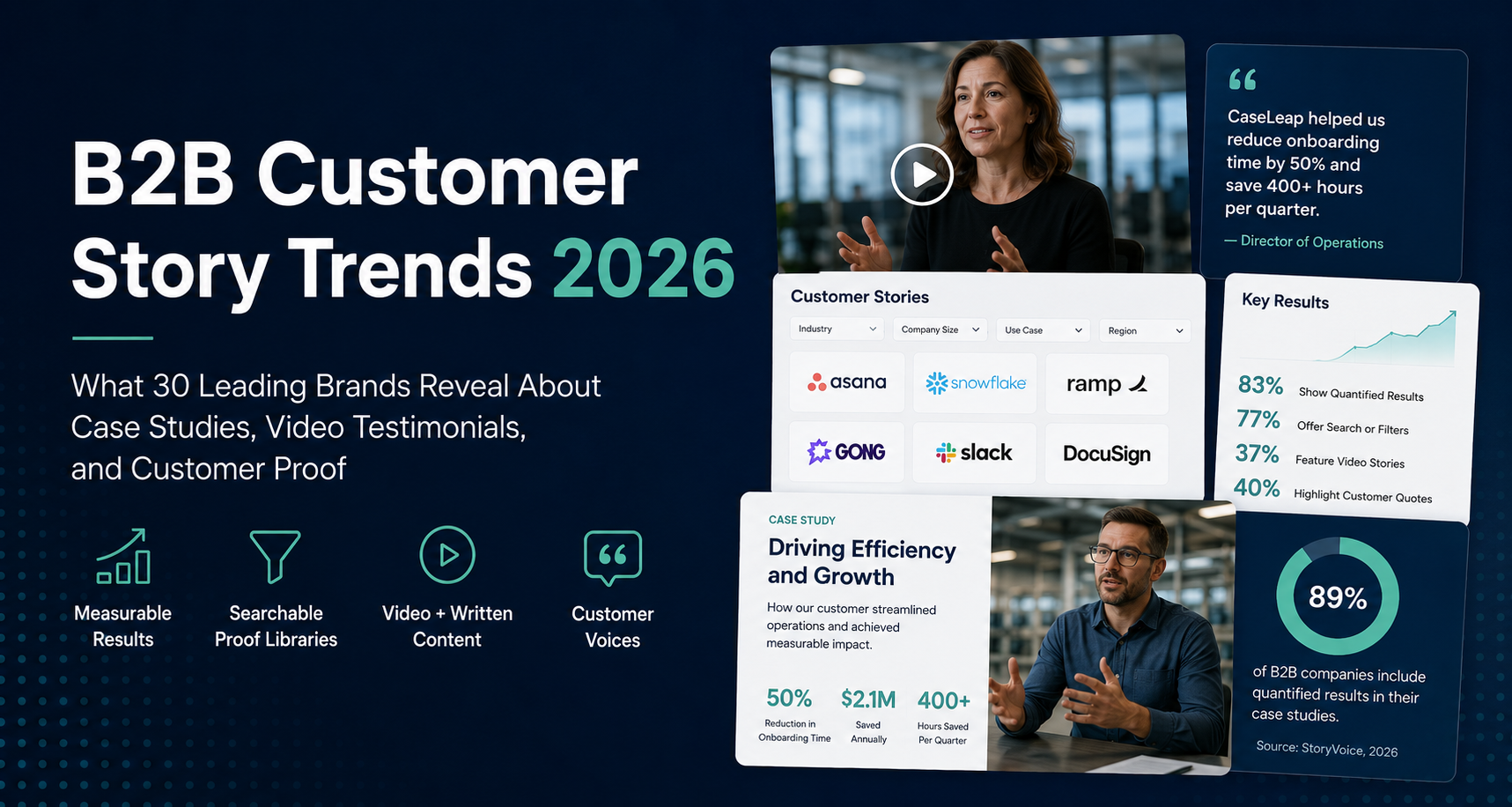
Quantified outcomes surfaced on the customer story library - 25 of 30 (83%)
Search or filtering to help visitors find relevant stories - 23 of 30 (77%)
Video clearly offered as a customer story format - 11 of 30 (37%)
Customer quotes prominently surfaced on the main library - 12 of 30 (40%)
The takeaway is not that every B2B company needs to copy these exact percentages.
It is that mature customer proof programs are increasingly designed around four things: specificity, relevance, accessibility, and format choice.
And there is still a large gap between companies that have developed this kind of customer proof infrastructure and those that have not.
StoryVoice's 2026 Customer Proof Index crawled 1,000 B2B software companies, with 954 usable websites. It found that 61% published at least one written case study, while 39% had no written case study at all. Of that 39%, 21.5% had no customer proof and another 17.5% relied on video-only proof without a written companion.
The gap suggests something important: customer proof may be common, but sophisticated customer proof programs are far from universal.
Trend 1: Customer results are moving front and center
The clearest pattern in our audit was the prominence of measurable results.
25 of the 30 customer story libraries we reviewed surfaced some form of quantified customer outcome before the visitor even opened the complete story.
The numbers were often part of the headline itself.
Asana highlights stories such as customers saving $600,000 annually, cutting operating costs by 40%, or increasing work capacity. Gong surfaces improvements to deal size, win rates, ramp time, and pipeline growth. Samsara leads with dollars saved, accident reductions, and hours reclaimed. Ramp's library is filled with results such as faster month-end close, hours saved, and millions of dollars identified or saved.
This is consistent with broader research.
StoryVoice found that 89.3% of the companies where it could inspect a real customer story included a quantified result somewhere in the sampled stories.
A customer saying your product or service was "great" provides social proof.
A customer explaining that it reduced onboarding time by 50%, saved 400 hours, increased conversion by 20%, or replaced three separate tools gives the buyer evidence.
Whenever possible, customer interviews should be designed to uncover:
Time saved
Cost savings
Revenue or pipeline impact
Productivity improvements
Risk reduction
Speed improvements
Adoption or engagement changes
Operational improvements
Before-and-after differences
Not every customer will be able to share revenue figures or confidential performance data. That does not make the story unusable.
CaseLeap's guide to creating a case study without metrics covers ways to demonstrate meaningful results when hard numbers are unavailable.
Operational outcomes, time savings, specific improvements, and credible customer observations can still make a story significantly stronger than generic praise.
Trend 2: Customer story libraries are becoming searchable proof databases
Another major pattern was how companies organize their stories.
23 of the 30 libraries we reviewed provided meaningful search, filters, or segmentation.
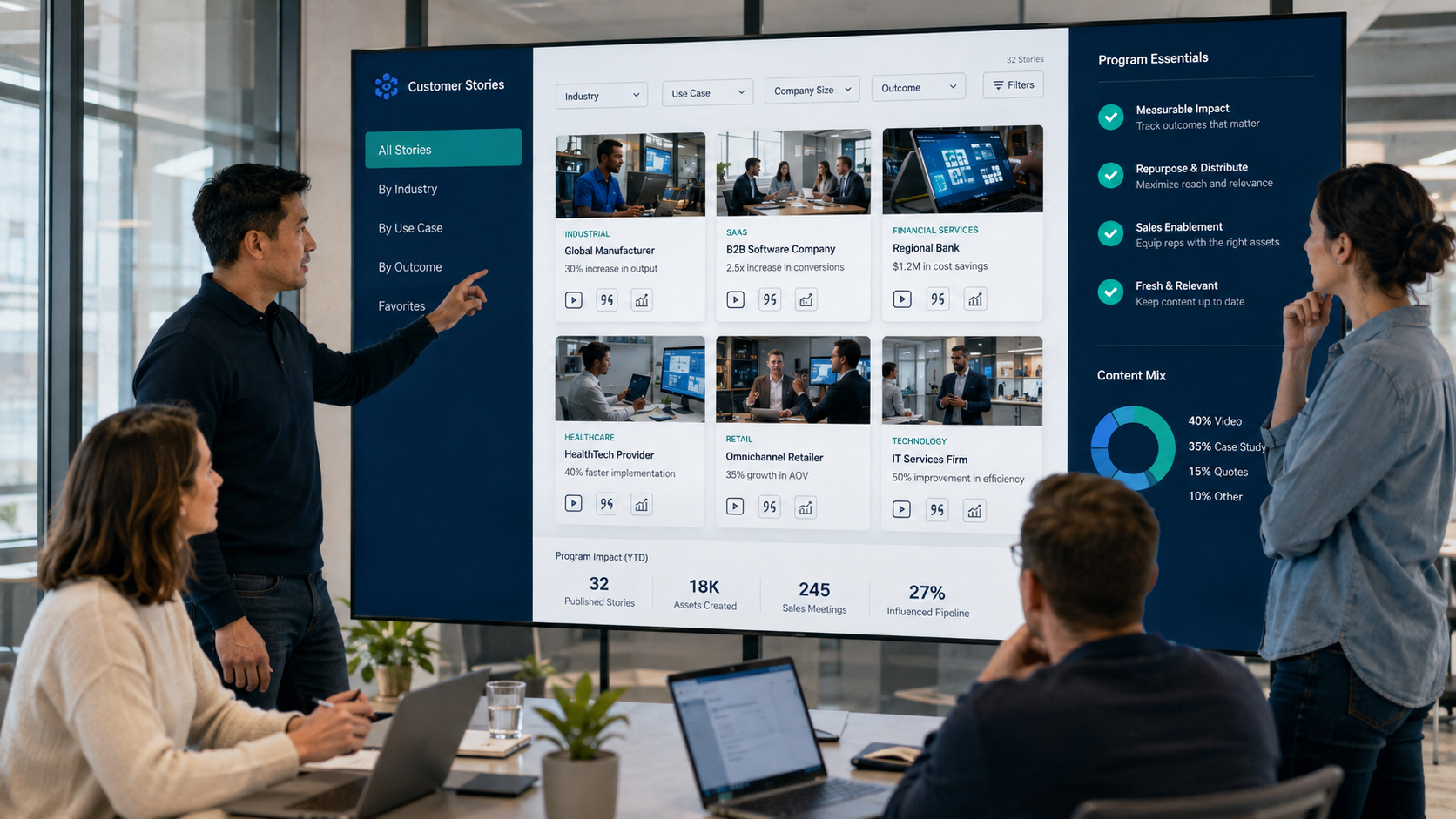
Slack lets visitors filter customer stories by industry, department, company size, and region. Gong uses filters for use case, industry, company size, and region. Snowflake goes even further, allowing visitors to filter by content type, industry, product category, department, and region. Deel organizes stories by company size, region, use case, and industry. Figma allows visitors to narrow customer stories by dimensions including industry, region, and product.
That reflects a shift in what a case study library is supposed to do.
A prospect evaluating a product rarely wants to read a random customer story.
They want to know:
"Do you work with companies like mine?"
"Have you solved this problem before?"
"Do you understand my industry?"
"Can you handle a company our size?"
"Has someone used this particular product or service successfully?"
A library containing 50 customer stories is much less useful if the visitor cannot quickly find the three that matter to them.
Think about coverage, not just volume
This also changes the question from:
How many case studies should we have?
to:
Do we have the right case studies?
A useful customer story library might need coverage across:
Proofmap's analysis found an average of 45 case studies among the fast-growing SaaS companies it reviewed, but volume alone is not the goal.
The better benchmark is whether your available stories cover the situations your prospects need validated.
This is also where a broader customer advocacy program can become valuable. Instead of approaching customer stories one at a time, companies can create a repeatable process for identifying advocates and turning successful customer relationships into useful marketing and sales assets.
Trend 3: Video is important, but the strongest strategy is video plus written content
Video showed up clearly as a customer-story format in 11 of the 30 libraries we reviewed, or approximately 37%.
That result closely mirrors Proofmap's separate analysis of fast-growing SaaS companies, where 36% incorporated video into their case studies.
Companies taking a particularly visible multi-format approach include Asana, monday.com, Airtable, Snowflake, DocuSign, Zoom, ServiceNow, and Figma. Some allow visitors to choose between reading a case study and watching a customer video; others mix video stories directly into the broader customer library.
But the data also points to an important limitation of video-only customer proof.
StoryVoice found that 17.5% of the B2B software companies it analyzed used video proof but did not have a written case study.
For buyers, search engines, and AI tools, those formats serve different functions.
Video customer testimonials are strong for:
Authenticity
Emotional credibility
Hearing the customer's tone and enthusiasm
Building confidence quickly
Social media and paid campaigns
Sales presentations
Landing pages
Written case studies are strong for:
Detailed evaluation
SEO
AI search visibility
Scanning for specific results
Quoting customer outcomes
Internal sharing
Sales follow-up
Longer buyer research
For many B2B companies, the better question is not whether to create a written case study or a video testimonial.
It is how to turn one customer participation opportunity into both.
A well-planned interview can potentially produce a full testimonial video, shorter video clips, written case study content, customer quotes, sales proof points, social content, and website assets.
CaseLeap's guide to repurposing testimonial videos includes 25 ways to extend one customer story into additional marketing and sales assets.
For companies that also need broader brand, product, campaign, or corporate video beyond customer testimonials, Levitate Media provides a wider range of video production services.
Trend 4: Case studies are being built for buyers who want proof quickly
The structure of customer story libraries also reflects how B2B buyers consume information.
Companies including HubSpot, Notion, monday.com, Ramp, Brex, and DocuSign surface key results immediately instead of requiring users to read the entire story to understand the outcome.
That matters because B2B buyers are increasingly evaluating vendors before having a sales conversation.
Redpoint Insights' research with 250 B2B buyers found that the content elements buyers most commonly associated with trust included original research at 70%, expert opinions at 64%, peer insights at 62%, customer testimonials at 55%, and case studies at 54%.
The lesson is straightforward: buyers want evidence, but marketers should not make them work to find it.
A strong customer story should make several things easy to identify:
Who the customer is
What problem they had
What they used
What changed
What measurable result they achieved
What the customer says about the experience
The complete narrative still matters. But the core proof should be understandable in seconds.
This is one reason the questions asked during the interview matter so much. Good video testimonial questions should uncover the challenge, decision, experience, and outcome rather than simply inviting a customer to say something positive.
Trend 5: A large customer story library can become a sales enablement system
Some of the libraries in our audit are substantial.
Asana currently surfaces more than 170 customer stories. Intercom lists more than 100. Cloudflare's library contains more than 250 case studies. Snowflake lists more than 300 pieces of customer content across formats. Figma surfaces more than 120 customer stories.
That scale creates a different opportunity.
Instead of treating customer stories purely as website content, marketers can build a library that sales teams use strategically.
A rep preparing for a healthcare prospect could pull healthcare stories.
A rep selling an enterprise implementation could pull enterprise stories.
A prospect concerned about implementation could receive a story specifically addressing implementation.
A buyer asking about ROI could receive a story centered on measurable financial results.
The better the customer proof is categorized, the easier it becomes to match the right proof with the right sales conversation.
That is also why customer stories belong inside a broader sales enablement content library, rather than living only on the marketing website.
Trend 6: Freshness is an overlooked customer proof problem
Producing customer stories is only part of the job.
Keeping them current is another.
StoryVoice found that among the companies whose stories had reliable machine-readable publication dates, the median newest story was about 9.9 months old. More than 44% had not published a new customer story in over a year.
Old customer stories are not automatically bad.
A five-year-old case study can still be valuable if the customer relationship, product, and results remain relevant.
But aging libraries create several potential problems:
The featured product may have changed
Brand positioning may be outdated
Customer titles may no longer be accurate
Metrics may no longer reflect current capabilities
Design and production quality may feel dated
New industries or use cases may be missing
The stories may no longer match current sales priorities
For companies with an established library, the answer may not always be producing more.
It may be identifying where the proof is thin, outdated, or poorly aligned with the current ICP.
Trend 7: Customer proof needs to work for AI search as well as human buyers
There is another audience consuming B2B content in 2026: AI systems.
That has implications for how customer stories are published.
Video remains valuable, but important proof should also exist in crawlable text.
A video testimonial containing an excellent customer quote, a specific business challenge, and a 40% performance improvement loses significant search value if none of that information appears anywhere on the page.
For AI and search visibility, customer story pages should clearly state:
Customer name
Industry
Company type or size when relevant
Problem or use case
Solution
Specific outcomes
Direct customer quotes
Video transcript or substantial written summary
Related products or services
This is another argument for thinking beyond the finished video itself. CaseLeap's guide to creating a video case study covers how customer stories can combine narrative, proof, and video into a more complete marketing asset.
The bigger principle is making the underlying customer proof clear, structured, and machine-readable.
That benefits human visitors, traditional search, and AI-driven discovery at the same time.
What does a strong B2B customer story program look like in 2026?
Based on our audit and the broader research, the strongest programs share several characteristics.
They do not simply collect testimonials.
They build an organized body of customer proof.
A modern customer story program should aim to:
Capture specific outcomes. Look beyond generic praise and identify what materially changed for the customer.
Cover the important segments of your ICP. Prioritize customers based on industry, company size, use case, buyer role, and sales need.
Make stories easy to find. Use filters, categories, or clear navigation once the library becomes large enough.
Use video and written formats together. Let video provide authenticity while written content supplies depth, searchability, and context.
Repurpose each interview. One customer conversation can support far more than one final asset.
Connect proof to the buyer journey. Customer stories should appear on relevant product pages, landing pages, sales materials, and campaigns, not only in a customer story directory.
Keep the library current. Audit customer stories regularly for stale products, missing segments, and outdated positioning.
Publish customer proof in AI-readable formats. Do not hide the most valuable facts exclusively inside video, graphics, or PDFs.
If customer participation is the bottleneck, start there. CaseLeap's guide on how to ask for a testimonial includes scripts, email templates, and approaches for making the request easier for customers to say yes to.
How many customer stories does a B2B company need?
There is no universal number.
Uplift Content's research found that SaaS companies had an average of 50 active written or video case studies, while Proofmap's analysis of fast-growing SaaS companies found an average of 45.
Those averages are useful benchmarks, but they should not become quotas.
A company with 12 strategically chosen stories covering its major industries, buyer types, and use cases may have a more useful customer proof library than a company with 50 nearly identical stories.
The better question is:
When a qualified prospect wants proof that you can solve their specific problem, do you have a relevant customer story to show them?
If the answer is frequently no, that is the gap to fill.
The state of B2B customer stories in 2026
Customer stories are becoming more useful because the best companies are treating them as evidence rather than decoration.
Our review of 30 established B2B customer-story programs found that:
83% surfaced quantified customer outcomes directly in the library
77% offered meaningful ways to search or filter customer proof
37% clearly incorporated video as a customer-story format
40% prominently surfaced the customer's own voice through quotes
At the same time, broader market research shows there is still plenty of room for improvement. StoryVoice found that 39% of the B2B software companies it crawled had no written case study at all, while many existing case study libraries are aging.
For marketers, the opportunity is not simply to produce more case studies.
It is to build a better customer proof system: one that captures credible stories, makes results easy to understand, gives buyers relevant examples, works across written and video formats, and turns each customer interview into an asset that can support marketing and sales long after production ends.
Methodology
CaseLeap reviewed the publicly accessible customer story, customer success, or case study libraries of 30 B2B and SaaS brands on August 26, 2026.
Each public library was reviewed for four visible characteristics:
Whether visitors could meaningfully search, filter, or segment customer stories
Whether quantified customer outcomes were surfaced on the main library page
Whether video was clearly presented as a customer story format
Whether direct customer quotes were prominently surfaced on the main library page
This was a directional review of established customer-story programs, not a random sample of all B2B companies. It should not be used to estimate the percentage of B2B companies that have customer story programs.
Broader adoption statistics in this article are drawn from larger third-party datasets, including StoryVoice's 2026 crawl of 954 usable B2B software websites, Proofmap's analysis of fast-growing SaaS companies, Uplift Content's case study research, and Redpoint Insights' B2B buyer research.
Build a Stronger Customer Story Library
Need more customer proof across your key industries, use cases, or buyer segments? CaseLeap makes it easier to capture professional customer stories at scale, with remote and on-site video testimonial production built around your customers and your sales goals.