Get a Video Gap Analysis for your company · See which videos could have the biggest pipeline impact
See Where Your Competitors Are Winning With Video Get a custom Video Gap Analysis for your company · See which videos could have the biggest pipeline impact
Thanks - our team will review your website and put together your personalized Video Gap Report. Expect it atthe email address you provided within 2 business days.
We'll put together a personalized report showing where video could have the biggest impact, how your competitors are using it, and specific opportunities for your team. You'll get strategic recommendations, not generic advice.
Thank you! Your submission has been received!
Oops! Something went wrong while submitting the form.
B2B Video Testimonial Script Examples: 7 Interview Frameworks That Sound Natural
Seven practical B2B video testimonial frameworks for creating customer stories that feel structured without sounding scripted
October 5, 2026
The best video testimonial scripts aren't really scripts at all. They don't tell customers exactly what to say.
They are more like a framework that gives the conversation a structure.
Without one, even a customer who loves your product can spend 20 minutes jumping between features, implementation, your team, and results without ever telling a clear story.
Go too far in the other direction and the testimonial starts sounding like an ad.
For B2B testimonial videos, the sweet spot is a structured interview framework: know the story you want to uncover, build questions around it, and let the customer answer in their own words.
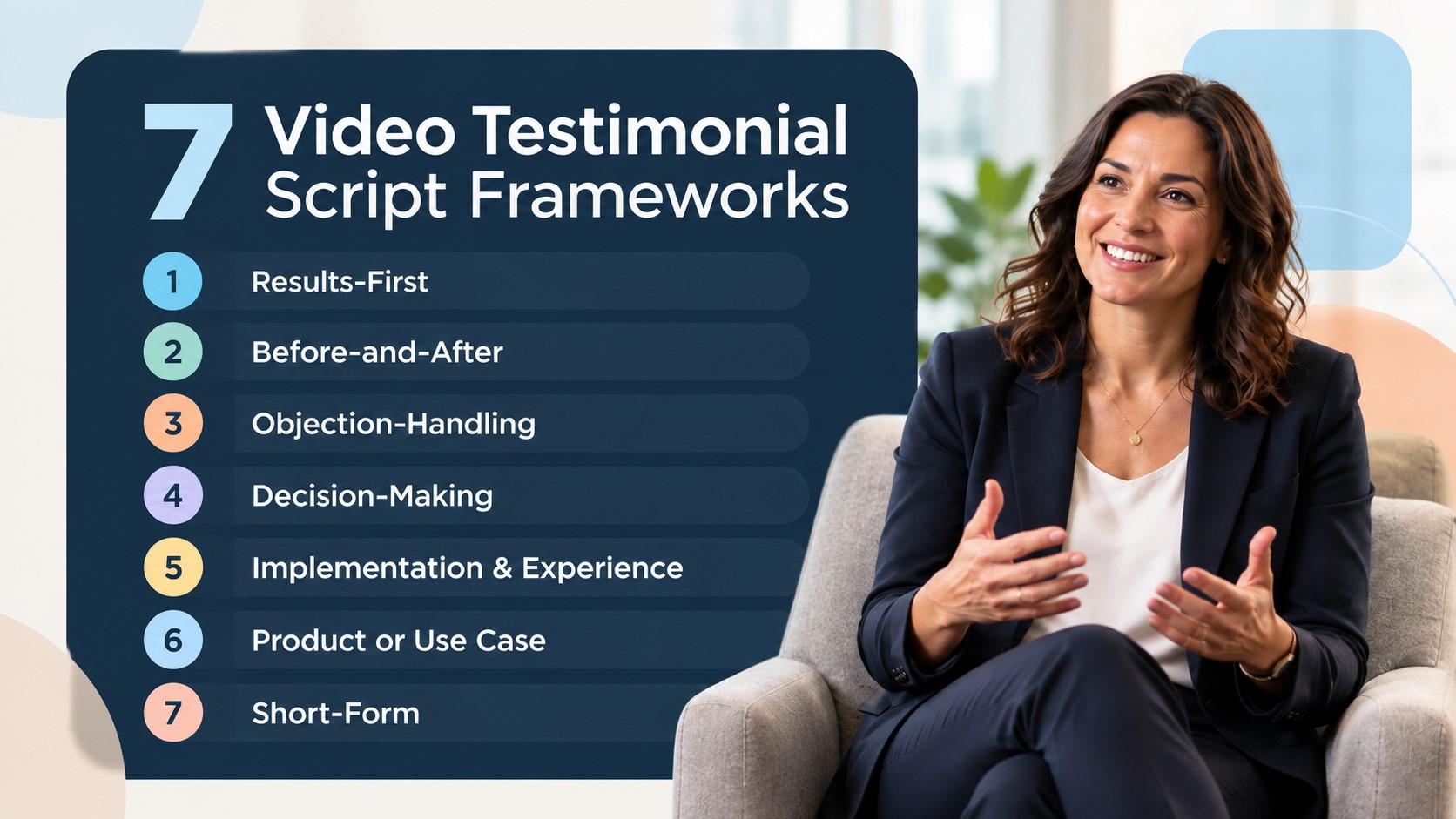
Below are seven video testimonial script examples you can use to guide different types of customer interviews, along with questions designed to produce natural, specific answers.
What Is a Video Testimonial Script?
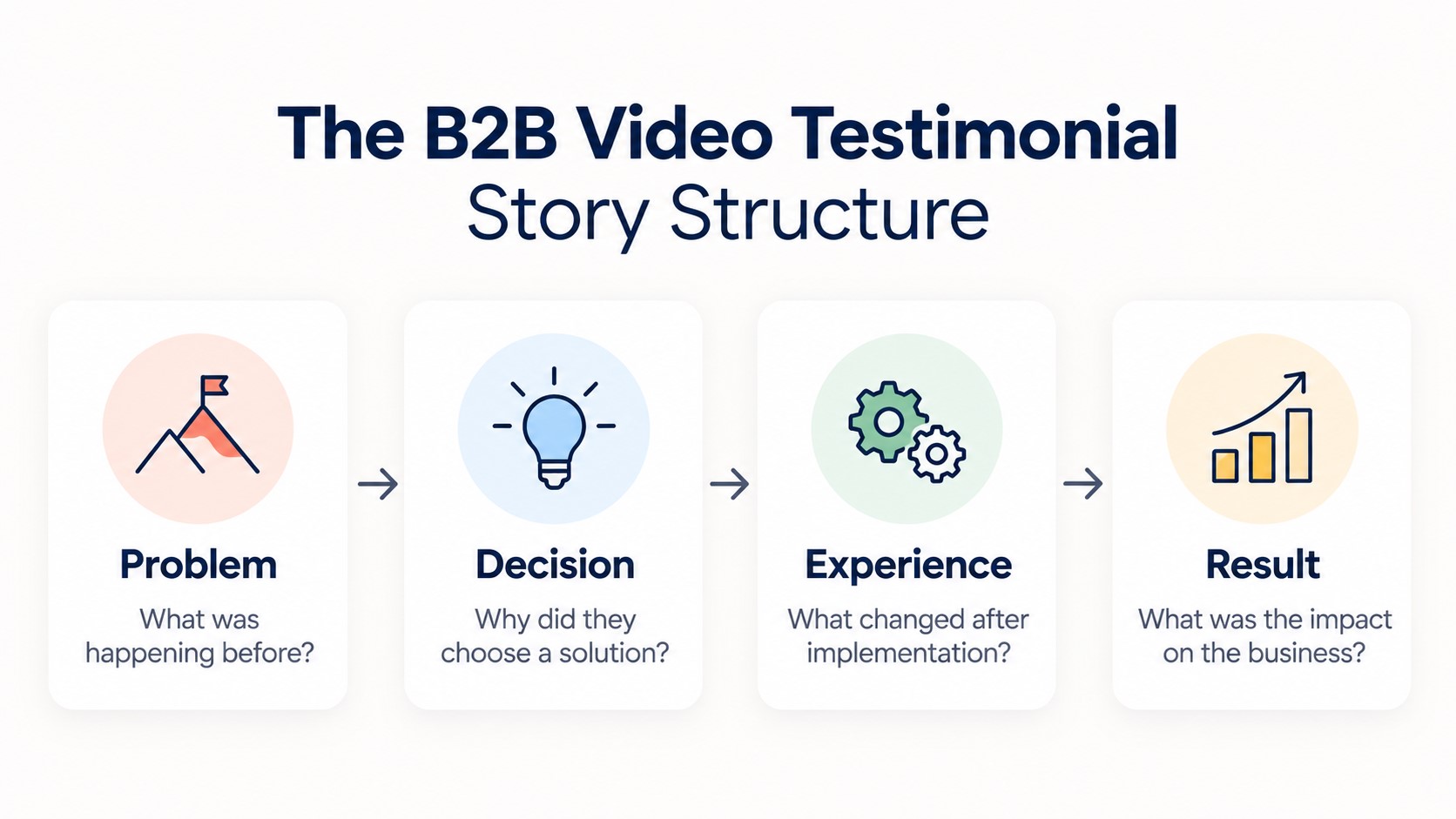
A video testimonial script is a framework that guides what a customer interview should cover and the order in which the story should unfold.
For most B2B testimonials, that usually means some variation of:
Problem -> Decision -> Experience -> Result
The customer explains what was happening before, why they looked for a solution, what changed after choosing one, and what the result meant for their business.
A testimonial script can be used in two ways:
As an interview framework: A producer asks open-ended questions and builds the finished story from the customer's answers.
As a recording guide: A customer receives prompts or talking points before recording their own testimonial.
For professionally produced B2B testimonials, the first approach usually creates a more natural result.
Customers should know what topics will be discussed. They should not need to memorize marketing copy.
Should You Script a Video Testimonial Word for Word?
Usually, no.
A word-for-word testimonial may give you tighter control over the message, but you often lose the thing that makes customer proof valuable in the first place: credibility.
Buyers can usually tell when someone is reciting approved language.
Instead, define the story you need and turn each part of that story into an interview question.
Rather than giving a customer this line:
"The platform streamlined our workflow and significantly improved team productivity."
Ask:
"Walk me through how your team's workflow changed after you started using the platform."
You may get an answer like:
"Before, three people were spending most of Monday pulling reports together. Now it takes one person about an hour."
That answer is more specific, believable, and useful.
A strong testimonial framework creates direction without putting words in the customer's mouth.
That matters from a compliance perspective, too. The FTC's guidance on endorsements and testimonials says endorsements should reflect honest experiences and should not make deceptive or unsupported claims.
In other words: guide the story. Do not manufacture it.
1. The Results-First Video Testimonial Script
Best for: Customers with strong metrics or measurable outcomes
If the customer has an impressive result, do not wait until the final 20 seconds of the video to mention it.
Lead with it.
Then use the rest of the interview to explain where the result came from.
Story Structure
Strongest result
What the situation looked like before
What changed
How the solution contributed
Why the result matters
Interview Questions
What result are you most proud of?
Can you quantify that change?
What did that number look like before?
What changed to make that improvement possible?
What has that result meant for the business?
Has the impact extended beyond the original goal?
Example
A customer could open with:
"We cut our onboarding process from three weeks to nine days."
Then explain why onboarding was taking so long, what changed, and what faster onboarding means for customers and the internal team.
The metric gets attention.
The story gives it meaning.
What If the Customer Cannot Share Metrics?
Not every customer can disclose revenue, ROI, conversion rates, cost savings, or other internal numbers.
That does not mean the testimonial has to be vague.
Look for other evidence of change:
Faster workflows
Fewer manual steps
Reduced complexity
Better visibility
Easier collaboration
Faster decision-making
Improved customer experience
Increased team confidence
New capabilities
Specific outcomes still matter even when there is no percentage attached to them.
Sometimes the strongest story is simply the contrast between how things worked before and how they work now.
This framework works especially well when the customer can describe a frustrating process, inefficiency, or limitation that buyers in the same role will immediately recognize.
Story Structure
Before: What was difficult?
Change: What did the customer do differently?
After: What does the same situation look like now?
Interview Questions
What did this process look like before?
Where were the biggest frustrations or bottlenecks?
How much time or effort did the old process require?
What changed after implementation?
What does the same process look like today?
What difference has that made for your team?
Example
Instead of:
"Implementation was easy and the product saves us time."
Look for something closer to:
"We used to have three people touching every request before it went out the door. Now one person can manage the process from start to finish."
The contrast makes the benefit concrete.
3. The Objection-Handling Video Testimonial Script
Best for: Complex or high-consideration purchases
One of the most useful things a customer can say is:
"I had the same concern you probably have."
A testimonial can address an objection more credibly than your own sales copy because the reassurance is coming from someone who actually made the decision.
The key is finding customers who genuinely had that concern before buying.
Story Structure
What made the customer hesitate
Why the concern mattered
What convinced them to move forward
What actually happened
How they feel about the concern now
Interview Questions
What concerns did you have before moving forward?
Was there anything that almost stopped you from choosing the solution?
What gave you confidence to proceed?
How did the actual experience compare with what you expected?
Looking back, how would you respond to someone with the same concern?
This framework is especially useful when buyers regularly worry about:
Implementation
Cost
Switching from an existing solution
Internal adoption
Security
Integration
Time to value
Disruption to existing workflows
Instead of having your sales team repeatedly answer the objection, the customer answers it for you.
4. The Decision-Making Video Testimonial Script
Best for: Competitive markets and complicated buying decisions
Buyers rarely choose a B2B product or service without evaluating alternatives.
That decision process can make a strong testimonial story.
This framework focuses less on "we are happy with the company" and more on why the customer chose the company in the first place.
Story Structure
What triggered the search
What criteria mattered
What alternatives were considered
Why the customer chose the solution
Whether the decision proved to be the right one
Interview Questions
What made you realize you needed a new solution?
What were the most important criteria during your search?
What other approaches or alternatives did you consider?
What stood out during the evaluation process?
Why did you ultimately choose this solution?
Has the experience matched what you expected when you made the decision?
This type of testimonial can be especially effective near the bottom of the funnel because the customer is describing a decision your prospective buyer may be making right now.
5. The Implementation and Customer Experience Script
Best for: Buyers who worry about what happens after the contract is signed
Results matter.
But sometimes the biggest sales objection is getting there.
A prospect may believe the product works and still hesitate because they expect implementation to be painful, time-consuming, or disruptive.
This framework focuses on the experience between purchase and outcome.
Story Structure
Expectations before implementation
How onboarding worked
What support looked like
Any challenges
How quickly the customer reached value
What stood out about the experience
Interview Questions
What were you expecting implementation to be like?
How did the actual process compare?
What did onboarding look like for your team?
How involved did your team need to be?
Was there a moment where the support team really stood out?
How quickly did you start seeing value?
What would you tell another customer who is worried about implementation?
This is particularly valuable when your sales team frequently hears some version of:
"This sounds great, but we do not have time for a complicated rollout."
6. The Product or Use-Case Video Testimonial Script
Best for: Showing how a particular product, feature, or workflow creates value
Not every testimonial needs to cover the customer's entire relationship with your company.
Sometimes the most useful story is narrower.
A use-case testimonial focuses on one problem, one workflow, or one way the customer uses the solution.
Story Structure
Specific problem or use case
What the customer used before
How they use the product now
What changed
Who benefits
Why that improvement matters
Interview Questions
What are you using the product to accomplish?
How were you handling that process before?
Can you walk us through how you use it today?
Which part of the solution is most useful for your team?
What has improved as a result?
Who on your team benefits most from that change?
How does this affect the larger business?
This structure works especially well when one company uses your solution in several different ways.
Instead of trying to explain everything in one video, you can create customer proof around the use case most relevant to a particular audience.
7. The Short-Form Video Testimonial Script
Best for: Ads, landing pages, social media, sales outreach, and short clips
Not every testimonial needs a two-minute story.
Sometimes you need 20 to 45 seconds that makes one strong point.
For short-form testimonial content, narrow the scope.
Do not try to fit the customer's entire experience into a tiny edit.
Simple Structure
Problem -> Change -> Result
Questions to Ask
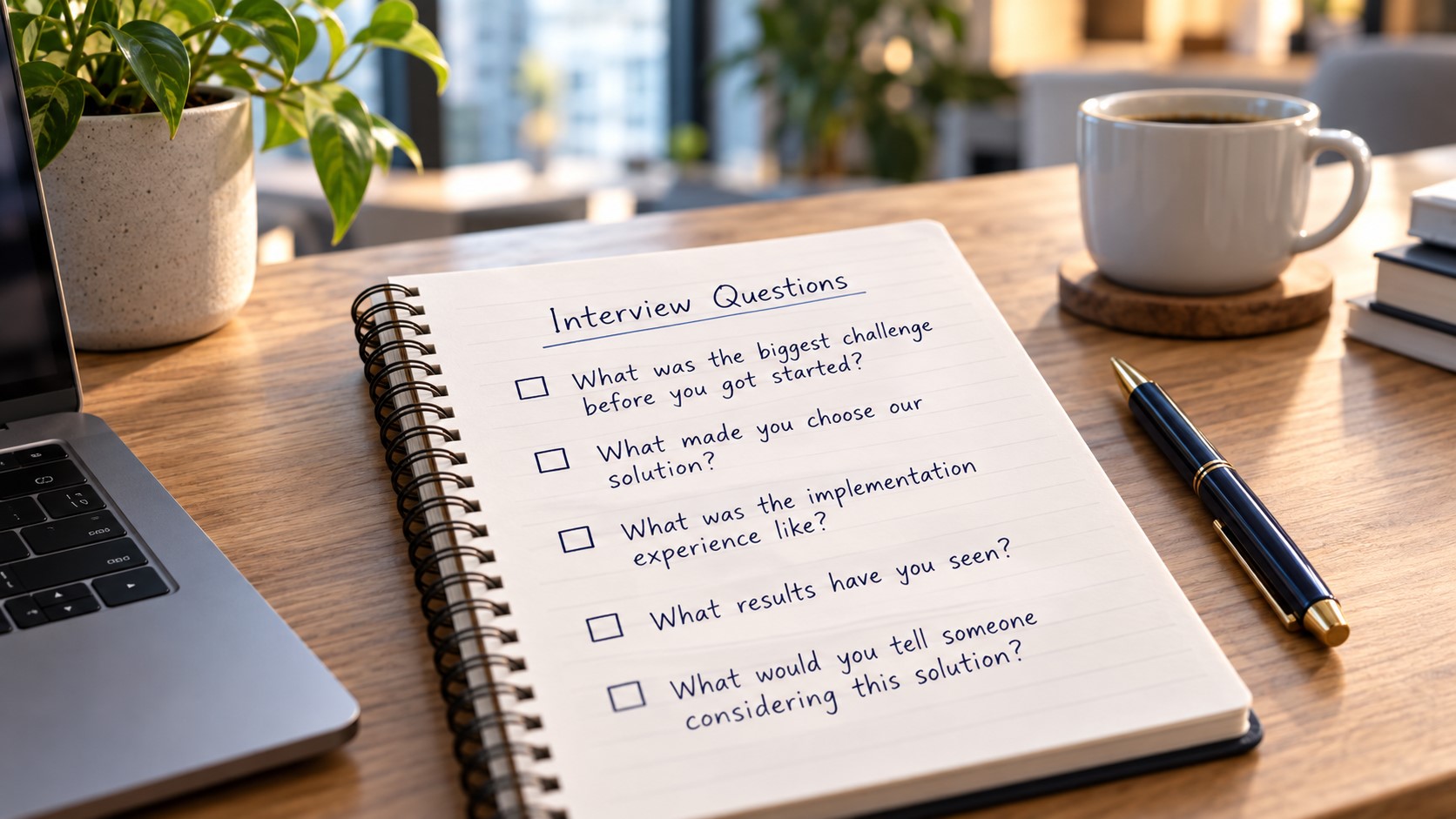
What was the biggest problem you needed to solve?
What changed after working with us?
What is the biggest result you have seen?
Or build the clip around a single question:
What surprised you most?
What would you tell someone considering this solution?
What result has made the biggest difference?
What was your biggest hesitation before getting started?
A longer customer interview can also produce several short testimonial clips.
One conversation might give you:
A results clip
An objection-handling clip
A short recommendation
A product-specific clip
A before-and-after story
A quote for a written case study
That is one reason it is worth thinking about the interview structure before recording begins.
Planning a testimonial project? CaseLeap handles the strategy, customer preparation, interviewing, production, and editing, so your customers can speak naturally while your team gets the proof it needs. Explore our B2B testimonial video production services or tell us about your project.
How to Turn a Video Testimonial Script Into Better Interview Questions
Once you choose a framework, do not simply read each section to the customer as a checklist.
Turn the framework into open-ended questions.
Instead of: "Did the product make your reporting process faster?"
Ask: "Walk me through how reporting worked before and how it works now."
Instead of: "Was implementation easy?"
Ask: "What was implementation actually like for your team?"
Instead of: "Would you recommend the product?"
Ask: "What would you tell someone in your position who is considering it?"
Open-ended questions create stories. Leading questions tend to create agreement.
You also need follow-up questions.
If a customer says:
"It saved us a lot of time."
Ask: "How much time?"
If they say:
"Implementation was really easy."
Ask: "What made it easy?"
If they say:
"The team was great."
Ask: "Was there a particular moment that stands out?"
Video Testimonial Script vs. Testimonial Questions
The two are related, but they are not the same thing.
A video testimonial script defines the story structure.
Your video testimonial questions are the prompts you use to uncover that story.
For example:
Script
Result -> Problem -> Change -> Impact
Questions
What result have you seen?
What was happening before?
What changed?
Why does that result matter?
Think of the script as the destination and the questions as the route you use to get there.
This is also why you do not need to ask every customer the same questions.
Start with the story you need.
Then choose the questions most likely to uncover it.
How Much Should You Prepare a Customer Before the Interview?
Prepare them enough to feel comfortable, but not enough to rehearse every sentence.
Before recording, customers should generally know:
How long the interview will take
Who will be interviewing them
What general topics will be covered
The types of questions you plan to ask
How the finished video will be used
Whether specific metrics or sensitive topics may come up
Sending questions or broad topics in advance can reduce anxiety, especially for busy executives or customers who are not comfortable on camera.
What you generally do not need is a fully written speech.
The goal is confidence, not memorization.
And the preparation starts before the interview invite. If getting customers to participate is the bigger challenge, see how to ask for a customer testimonial for outreach scripts, timing, and ways to make the request easier to say yes to.
Plan for Approval Before You Record
A good interview can still become a frustrating project if nobody knows what the customer will actually be allowed to approve.
Before production, clarify:
Whether the company name and logo can be used
Which results or metrics can be discussed publicly
Whether product screens or facilities can be shown
Who needs to approve the final video
Whether legal or communications teams need to review it
Where the finished testimonial can be used
Whether paid advertising usage requires separate approval
This is especially important for enterprise, healthcare, financial services, and other companies with formal review processes.
The best time to discover that your customer's legal team will not approve a revenue figure is before the interview, not after you have built the entire edit around it.
One Interview Can Create Multiple Customer Proof Assets
You do not necessarily need a different customer interview every time you need a different marketing asset.
A well-planned 20- to 30-minute conversation can give you enough material to create several versions of the same customer story.
For example:
Full customer story: Problem -> Decision -> Experience -> Result
Landing-page clip: Problem -> Result
Paid social clip: Result -> Recommendation
Sales enablement clip: Objection -> Experience
Product page clip: Feature -> Use case -> Outcome
Written case study: Challenge -> Solution -> Results
This is where planning the testimonial before production starts pays off.
You are not simply recording one finished video.
You are capturing a library of customer proof that can be shaped around different buyer questions and stages of the funnel.
The Best Video Testimonial Script Does Not Sound Scripted
A useful video testimonial script gives the interview direction without taking control of the customer's words.
Know what story you want to uncover.
Choose the framework that fits that story.
Prepare open-ended questions.
Ask follow-ups when the customer says something interesting.
Then let them talk.
The strongest customer testimonials rarely come from getting someone to say exactly what the marketing team planned.
They come from creating the right conditions for the customer to explain, in their own words, what changed and why it mattered.
Ready to Turn Customer Stories Into Sales Assets?
CaseLeap creates on-site and remote testimonial videos built around the proof your buyers actually need.
We help with customer preparation, interview strategy, production, editing, and repurposing, so one conversation can become a full customer story plus shorter assets for your website, sales team, social channels, and campaigns.
A video testimonial script should usually cover the customer's original problem, why they chose a solution, their experience using it, and the outcome they achieved. The exact structure should change depending on the story you want the testimonial to tell.
Should customers memorize a testimonial script?
Usually not. Giving customers word-for-word copy can make a testimonial sound rehearsed. A better approach is to share the topics and questions in advance and let the customer answer naturally during the interview.
How long should a video testimonial script be?
The final video may range from a short 20- to 45-second clip to a two- or three-minute customer story. Instead of writing a script to a specific word count, structure the interview around the information you need and create the appropriate edit afterward.
What questions should you ask for a video testimonial?
Strong testimonial questions uncover the customer's situation before the purchase, their decision process, experience, results, and recommendation. Use open-ended questions that encourage specific stories rather than yes-or-no answers.
What is the best structure for a B2B video testimonial?
There is no single structure that works for every customer. Results-first works well when a customer has a strong measurable outcome. Before-and-after is useful for clear transformations. Objection-handling and decision-making frameworks are particularly useful for bottom-of-funnel content.
The right structure depends on what makes that customer's story useful to the next buyer.
Can one testimonial interview create multiple videos?
Yes. A longer interview can be edited into a full customer story plus shorter clips focused on results, objections, features, recommendations, or other themes. Planning those potential outputs before the interview helps ensure you capture the right material.
Build trust and accelerate conversions
Contact us today. We'd love to help you supercharge your sales conversions.