Get a Video Gap Analysis for your company · See which videos could have the biggest pipeline impact
See Where Your Competitors Are Winning With Video Get a custom Video Gap Analysis for your company · See which videos could have the biggest pipeline impact
Thanks - our team will review your website and put together your personalized Video Gap Report. Expect it atthe email address you provided within 2 business days.
We'll put together a personalized report showing where video could have the biggest impact, how your competitors are using it, and specific opportunities for your team. You'll get strategic recommendations, not generic advice.
Thank you! Your submission has been received!
Oops! Something went wrong while submitting the form.
B2B Testimonial Ads: Formats, Strategy & Examples
Learn how B2B brands can turn customer testimonials into paid ads
September 8, 2026
B2B Testimonial Ads: Formats, Strategy & Examples
B2B ads have a credibility problem.
Every company can say its product saves time, improves performance, delivers better results, or makes customers happy. Buyers know those claims are coming from the company trying to sell them something.
A testimonial ad changes the source of the message.
Instead of your company making the claim, a real customer explains what changed, what results they achieved, or why they chose you.
That can make customer testimonials especially useful in B2B advertising, where purchases often involve higher costs, longer sales cycles, multiple stakeholders, and more scrutiny.
But simply putting a customer quote into an ad does not guarantee it will work.
The strongest B2B testimonial ads combine customer credibility with good advertising fundamentals: a specific hook, a relevant problem, a clear outcome, and creative built for the platform where it will run.
What is a testimonial ad?
A testimonial ad is an advertisement that uses the experience, words, results, or endorsement of a real customer as a central part of the creative.
In B2B marketing, testimonial advertising can include:
Short customer video clips
Customer quotes
Measurable results
Case study highlights
Before-and-after outcomes
Customer logos and names
Multiple-customer montages
Industry-specific customer stories
The difference between a testimonial ad and a traditional brand ad is primarily who provides the proof.
Instead of saying:
Our platform helps teams reduce onboarding time.
A testimonial ad might say:
"We cut onboarding time by 40%."
Then it identifies the customer, their company, and ideally enough context for the viewer to understand why that result matters.
Specific customer evidence can make the message more credible and more relevant to buyers facing the same problem.
Why use customer testimonials in B2B ads?
Customer testimonials add something that most paid creative cannot manufacture: third-party proof.
That is particularly valuable when the audience does not know your brand well yet.
A testimonial ad can quickly answer questions such as:
Do companies like ours use this?
Does it actually work?
What kind of result could we expect?
Who else trusts this company?
Has this solved the problem we are dealing with?
But testimonial ads can also work later in the buyer journey.
Someone who has already visited your website, viewed pricing, downloaded content, or engaged with your brand may not need another ad explaining what you do.
They may need evidence that choosing you is a safe decision.
That makes customer proof particularly useful for retargeting and other lower-funnel campaigns.
There is no single testimonial ad format that works for every campaign.
The best format depends on the customer story, the available footage, the audience, and what you are trying to communicate.
Here are six formats worth considering.
1. Results-first video testimonial ads
Start with the strongest result instead of beginning with a company introduction.
For example:
"We reduced implementation time from 12 weeks to 6."
Then let the customer briefly explain what changed.
This is often stronger ad creative than beginning with:
"Hi, I'm Sarah, VP of Operations at..."
The viewer can learn who Sarah is after you have given them a reason to keep watching.
Results-first ads are particularly useful when your customer can share a strong metric such as:
Cost savings
Time savings
Revenue growth
Increased productivity
Faster implementation
Higher conversion
Reduced risk
Improved customer satisfaction
No hard metric? That does not automatically disqualify the story. A testimonial can still communicate a concrete operational or qualitative outcome.
Our guide to creating a case study without metrics covers ways to establish meaningful results when customers cannot share specific numbers.
2. Short customer quote ads
A testimonial ad does not always need video.
One strong quote can become a simple static ad:
"We went from three tools to one and finally have a process the whole team uses."
Add:
Customer name
Job title
Company
Photo or logo when approved
The key word is strong.
"We loved working with them" may be a perfectly nice testimonial, but it tells a prospect very little.
Look for quotes that communicate a problem, outcome, differentiator, or decision.
3. Problem-to-solution testimonial clips
These ads build around a simple story:
Problem -> Change -> Result
For example:
"Our reporting process took the team two days every month. After moving to the new system, we were able to complete it in a few hours."
That is enough narrative for an ad.
You do not need to squeeze the customer's complete case study into a 20-second video.
A longer video case study can tell the full story. The ad's job is to extract the part most likely to matter to the specific audience seeing it.
4. Customer plus metric ads
This is one of the simplest ways to turn an existing case study into paid creative.
Make the measurable result the visual focus:
42% faster onboarding
Then add the customer and enough context to make the result credible.
This format works particularly well when the number can be understood almost immediately.
The metric should not require three sentences of explanation before it becomes meaningful.
5. Multi-customer proof ads
Sometimes the strongest message is not one customer story. It is the pattern across several.
A short video might combine three customers saying:
"Implementation was easy."
"We were live in weeks."
"Our team adopted it immediately."
Or the ad might quickly show several customer logos alongside individual results.
This can be useful when the campaign goal is broader category credibility rather than promoting one specific case study.
It also lets companies get more mileage from an established testimonial library.
6. Industry-specific testimonial ads
Instead of showing every prospect the same customer, match proof to the audience.
A healthcare buyer sees a healthcare customer.
A manufacturing prospect sees another manufacturer.
An enterprise buyer sees an enterprise implementation.
A marketing leader sees a customer talking about marketing results.
The underlying product may be identical, but the proof becomes more relevant.
This is one reason companies should think about their broader B2B case study strategy, not simply how many testimonials they have.
The question is whether you have the right customer proof for the buyers you are trying to reach.
B2B testimonial ad examples
You do not need dozens of examples to understand what makes testimonial advertising work. These three illustrate different ways B2B brands can turn customer proof into paid creative.
Hotjar: Match the testimonial to the audience
Hotjar has used LinkedIn image ads built around individual customer testimonials, including the customer's name and image.
What makes the approach useful for B2B marketers is its targeting potential.
Instead of treating "customer testimonial" as one universal creative concept, a brand can choose customers who resemble the audience receiving the ad.
The lesson:
The best testimonial is often the most relevant one, not necessarily the most impressive one.
A prospect is more likely to recognize themselves in a customer with a similar role, company type, industry, or challenge.
CloudZero: Lead with an actual business result
CloudZero has used customer testimonial video featuring Ben Johnson, co-founder and CTO of Obsidian Security, discussing the company's experience with the platform.
In CloudZero's own testimonial post, Johnson explains how the company used CloudZero to proactively control cloud costs and reports that Obsidian reduced its AWS bill by 25%. See CloudZero's original Obsidian testimonial post
That gives the testimonial something many ads lack: specificity.
The customer is not simply endorsing the company. He is providing a concrete reason the audience should care.
The lesson:
Give the customer something specific to prove.
A strong metric can become the hook for the ad, while the customer's explanation gives the number credibility and context.
Slack: Tell a customer story quickly
Slack's customer story featuring Caraway founder and CEO Jordan Nathan shows how a larger customer narrative can be condensed into a short video.
The short version quickly establishes that Caraway started using Slack before the company launched and continued relying on it while scaling the business. Watch the Slack and Caraway customer video
Slack also publishes the larger Caraway story on its website, where the company explains how Slack became part of its operating model as the team grew. Read the full Caraway customer story from Slack
The lesson is not that every testimonial ad needs to tell a complete case study.
It is that a B2B customer story can communicate meaningful scale and credibility in a very short window.
The paid ad and the complete customer story can do different jobs.
How long should a video testimonial ad be?
For paid social, shorter cuts are often worth testing.
LinkedIn recommends putting the most impactful content within the first 10 seconds of a video ad and testing different combinations of format, content, and length. See LinkedIn's current video ad guidance
For in-stream placements, LinkedIn recommends video ads between 15 and 30 seconds so they can qualify for all possible placements across the LinkedIn Feed and Audience Network. See LinkedIn's video placement recommendations
That does not mean every customer testimonial should be 15 seconds long.
It means you should distinguish between the master customer story and the ad creative made from it.
The production quality matters, but it is rarely the first thing that determines whether the creative is compelling.
A polished video built around a vague testimonial is still a vague testimonial.
Start with the substance.
Put the strongest point first
Do not assume viewers will wait for the payoff.
Open with:
"We saved 600 hours last year."
Not:
"We've been working with Company X for about three years..."
You can add the context afterward.
Make the customer identifiable
Whenever permissions allow, include:
Name
Role
Company
Logo
Face
Anonymous testimonials can still be useful, particularly in regulated or sensitive industries, but identifiable customers generally provide more context and credibility.
Keep each ad focused on one idea
One testimonial interview may contain ten excellent points.
That does not mean one ad needs all ten.
Create one cut about implementation.
Another about ROI.
Another about ease of use.
Another about customer support.
Now you have four creative angles from one interview.
Use captions and on-screen context
B2B viewers may encounter the ad without audio.
Make sure the central message can still be understood.
That may include:
Captions
Customer identification
Key result
Short headline
Brand identification
CTA
Avoid turning the frame into a wall of text.
Match the story to the audience
A good customer testimonial becomes much stronger when the viewer thinks:
That sounds like us.
Segment your creative when you have enough customer proof to do it.
Industry, job role, company size, use case, pain point, and buying stage can all provide useful ways to organize testimonial ads.
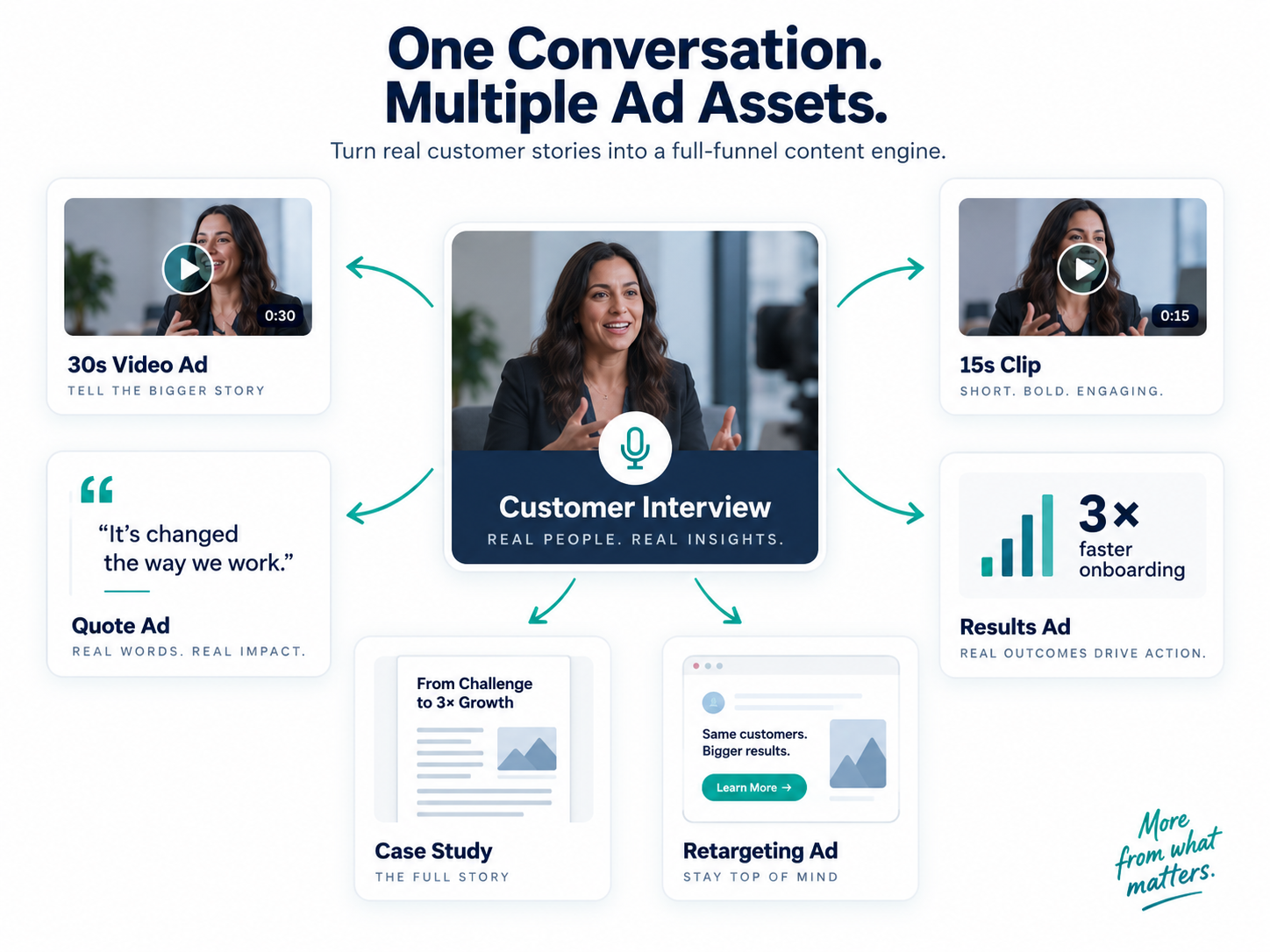
One customer interview can become an entire ad campaign
This is where testimonial advertising can become much more cost-effective.
You do not necessarily need to produce a new customer interview every time you need fresh paid creative.
A single well-planned customer story can potentially become:
1 full testimonial video
2 to 4 short video ads
Several individual soundbite clips
Static customer quote ads
Results-focused graphics
A written case study
Sales presentation proof
Landing page content
Organic social posts
Retargeting creative
Our guide to repurposing testimonial videos includes 25 ways to get more value from the footage and customer story you already captured.
This approach also changes how you should plan the original interview.
If you know the footage may become paid creative, ask questions that produce concise, standalone answers.
For example:
Instead of: "Tell us about your experience."
Ask: "What changed for your team after implementing the solution?"
Or ask:
"What measurable impact have you seen?"
"What would you tell another company considering this?"
"What was the biggest problem you needed to solve?"
The right channel depends on where your audience is and what campaign you are running.
LinkedIn
LinkedIn is an obvious testing ground for B2B customer proof because advertisers can align the customer story with professional audience attributes.
Try pairing:
Industry testimonial + industry targeting
Executive testimonial + executive audience
Product use case + relevant job function
Enterprise story + enterprise accounts
Meta
Meta can offer additional reach and is worth testing when your audience can be effectively identified there.
Short, visually clear customer clips are generally better suited to feeds than lengthy case study edits.
YouTube
Customer testimonial clips can work as video advertising around relevant content and audiences.
Again, get to the central proof quickly.
Retargeting
This may be one of the most natural uses of testimonial advertising.
Someone who already knows your company does not necessarily need another introduction.
Show them proof.
A visitor to a pricing page might see an ROI-focused testimonial.
Someone who visited an industry page might see a customer from that industry.
Someone researching a specific service might see a story about that exact service.
The closer the proof is to the prospect's actual concern, the more useful it becomes.
Do not assume testimonial ads will automatically outperform other creative
Customer proof is powerful, but "testimonial" is not a magic ad format.
The creative still needs:
A clear audience
A compelling hook
A specific message
Relevant proof
Good pacing
An appropriate CTA
A landing page that continues the story
Testimonial ads should be tested alongside other creative concepts rather than treated as a guaranteed winner.
For example, test:
Customer result vs. product benefit
Customer video vs. static quote
Metric-led vs. problem-led
15 seconds vs. 30 seconds
Industry-specific proof vs. general proof
The goal is not to prove that testimonial ads always win.
The goal is to find where customer proof helps your specific audience move closer to a decision.
Testimonial advertising and customer permissions
Before turning a customer story into an advertisement, make sure your company has the appropriate permission to use the customer's words, likeness, logo, and results in paid media.
The FTC's endorsement guidance states that advertising endorsements must be truthful and not misleading. It also addresses potentially misleading uses of unrepresentative results and material relationships that could affect how an endorsement is interpreted. Read the FTC's guidance on endorsements and testimonials
For B2B marketers, the practical rule is simple:
Do not turn a good customer story into a stronger claim than the customer can actually support.
Confirm what can be said, where it can be used, and how the customer should be identified before launching the campaign.
Testimonial ads vs. case study ads: What is the difference?
The terms overlap, but the emphasis is slightly different.
Testimonial ads center the customer's voice. They are often built around a strong quote, video clip, or soundbite and can work without telling the customer's full story. Their primary strength is credibility: prospects get to hear directly from someone who has already used the product or service.
Case study ads center more heavily on the customer's challenge, solution, and result. They often lead with an outcome or measurable metric and point prospects toward a larger customer story where they can learn more.
In practice, the same customer interview can produce both. A 15-second quote can become a testimonial ad, while another version might lead with the customer's strongest result and direct viewers to the full case study.
FAQs about B2B testimonial ads
What is testimonial advertising?
Testimonial advertising uses a real customer's experience, endorsement, quote, or results as part of an advertisement. B2B testimonial ads commonly use customer video clips, quotes, case study results, and customer logos to provide third-party proof.
Do testimonial ads work for B2B companies?
They can. Customer testimonials give prospects evidence from someone who has already used the product or service, which can help address skepticism and build credibility. Performance still depends on targeting, messaging, creative, offer, and campaign strategy.
What makes a good testimonial ad?
Strong testimonial ads are specific, concise, credible, and relevant to the target audience. They usually focus on one problem or result rather than trying to summarize the customer's entire experience.
How long should a video testimonial ad be?
There is no single ideal length, but short 15-to-30-second edits are useful for paid social testing. The strongest point should appear early rather than waiting until the end of the video.
Can you turn an existing testimonial video into an ad?
Yes. Existing customer testimonial footage can often be edited into shorter paid-social cuts, individual soundbites, results-focused clips, quote graphics, and other ad creative.
Should testimonial ads use customer metrics?
Metrics can make testimonial ads more specific and credible when the customer can provide and approve them. If hard numbers are unavailable, focus on concrete qualitative outcomes rather than generic praise.
What is the difference between a testimonial ad and UGC?
A testimonial specifically communicates a customer's experience with a company, product, or service. UGC is a broader category of customer-created or creator-style content and does not necessarily include an endorsement or customer success story.
Turn one customer story into more paid creative
A customer testimonial should not have to live as one video on one page.
With the right interview and production approach, the same customer story can support your website, case studies, sales team, organic social content, and multiple paid campaigns.