Get a Video Gap Analysis for your company · See which videos could have the biggest pipeline impact
See Where Your Competitors Are Winning With Video Get a custom Video Gap Analysis for your company · See which videos could have the biggest pipeline impact
Thanks - our team will review your website and put together your personalized Video Gap Report. Expect it atthe email address you provided within 2 business days.
We'll put together a personalized report showing where video could have the biggest impact, how your competitors are using it, and specific opportunities for your team. You'll get strategic recommendations, not generic advice.
Thank you! Your submission has been received!
Oops! Something went wrong while submitting the form.
Remote vs On-Site Video Testimonials: Which to Choose
Remote or on-site? Compare cost, timeline, quality and best fit for video testimonials, with a real CaseLeap example of each.
Liza Burke
Director of Marketing
November 19, 2026
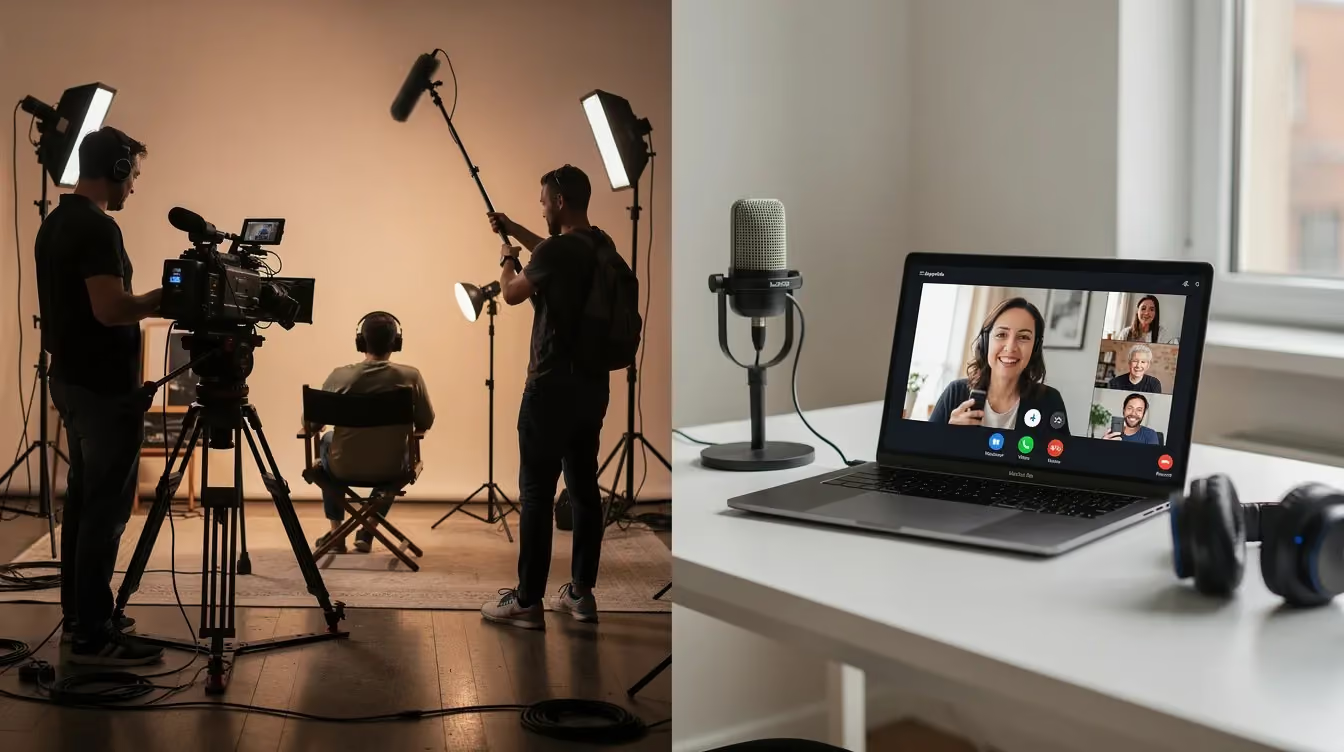
Remote video testimonials are recorded with the customer in their own office while a producer directs the interview over a remote recording platform. On-site video testimonials put a crew, lights and cameras in the customer's building. Remote costs less and books faster; on-site gives you more control over the picture and the B-roll that shows the customer's world.
Neither is the better format in general. The right one depends on how the video will be used, where your customer is, and what the story needs to show on screen.
We produce both every month at CaseLeap, so this guide compares them the way we explain it to clients: cost, timeline, quality and best fit, with a real example of each.
The short version: choose remote when the story lives in what the customer says, you need several videos, or your customer is hard to reach. Choose on-site when the place, the people or the product in use is part of the proof, or when the video will anchor your homepage, a paid campaign or a big sales push.
Remote vs on-site video testimonials, side by side
Price: remote recording packages run $3,449 (Core), $4,449 (Create) and $5,949 (Captivate), including $199 media licensing. On-site production typically runs $8,500 to $20,000, depending on crew size, locations, number of interviews and travel.
Timeline: remote is usually faster because there is no crew travel or location planning to book. On both formats, the customer's calendar is the longest wait.
Customer's time: remote asks for a short tech check and an interview of up to about an hour. On-site asks for a half or full day with a crew in the building.
Picture quality: on-site gives full control of lighting, sound, framing and multiple cameras. Remote quality depends on the customer's room, light and microphone, which a good producer manages but can't fully replace.
B-roll: on-site captures the customer's facility, team and product in use. Remote relies on graphics, screen recordings, stock footage or footage the customer supplies.
Best fit: remote for libraries of stories, dispersed customers, busy executives and tight deadlines. On-site for flagship stories, physical results, regulated or visual environments and hero placements.
For a full breakdown of what drives each price, see our guide to testimonial video cost.
What does a remote video testimonial look like?
QueBIT Consulting x Townsquare Media, a remote-recorded customer testimonial.
QueBIT Consulting is an analytics and planning consultancy, and this video is one of its customers, Townsquare Media, telling the story. We have recorded more than one QueBIT customer remotely. Lesson: when the proof is in what the customer says about working with you, remote recording lets a services firm build a set of customer stories without flying a crew to each one. Each new story costs a package, not a trip.
How we run a remote recording session
Story and questions first. We agree the story with you before anyone is on camera: the problem, the decision, the result. The interview questions come from that, not from a template.
Recording kit and tech check. For our remote packages we can ship the customer a recording kit, then run a tech check to set camera height, light, background and audio. When a customer only has one slot, we fold the tech check into the start of the interview.
A directed interview. A senior producer leads an interview of up to about an hour. We record on a remote studio platform that captures each person's video on their own computer instead of through a compressed call, so the footage holds up in the edit.
Paper edit, then video edit. The transcript is cut into a story script first. Then the footage is edited and graphics, B-roll and music are added.
From our production notes: on a recent multi-interview remote project, the second and third interviews cut together far more easily once the producer asked each speaker to restate the question at the start of their answer ("The reason we switched was…" rather than "Cost."). Each answer then stands alone without the interviewer's voice. We now coach this before every remote session.
"They're great at communication and are an extremely organized group." — Mariela L., enterprise customer, on G2
What does an on-site video testimonial look like?
Western Growers Family of Companies – Woolf Farming, filmed on-site.
Western Growers serves farming businesses, and this story comes from one of them, Woolf Farming. Lesson: for an agricultural customer, the location is half the message. A webcam in an office can't show the operation; a crew on location can, and that footage is what makes a buyer in the same industry believe the story applies to them.
How an on-site shoot day works
Pre-production. Story outline, interview questions, a shot list and a call sheet, plus any site rules (safety, privacy, areas the crew can't film).
Shoot day. A director runs the interview in person while the crew handles lighting, sound and cameras. Between interviews, the crew films B-roll: people at work, the product in use, the space.
Post-production. Editing, color, sound mix, graphics and cut-downs for ads, social and sales.
From our production notes: on a recent healthcare shoot, one on-site day covered two podcast episodes, two testimonial interviews of about 30 minutes each and a B-roll library of the clinic. The clinical setting limited where and when the crew could film, so the schedule was built around those rules before the crew arrived. If you are paying for a crew day, plan every asset you can get from it.
Your customer is far away or hard to schedule. An executive who won't give you a half day will often give you an hour.
You need several stories. Remote lets you record a set of customers in the same few weeks without travel for each one.
The proof is verbal. Software, consulting, financial and other services stories are often carried by what the customer says, supported by graphics.
Your deadline is close. No crew travel or location planning to book.
Your budget is per-video. Remote packages start at $3,449 with licensing included.
Remote with graphics: when there is little to film
Toray Composite Materials x Epic Air, a remote testimonial.
Toray Composite Materials America makes advanced composite materials, and this is a customer story with Epic Air. Lesson: a materials supplier's customer is rarely next door. Recording the customer remotely and supporting the interview with visuals keeps a technical B2B story moving without a crew on the customer's floor.
From our production notes: on a recent remote project for a large technology company, the customer had no B-roll to share. We combined the remote interview with stock footage and custom animation, and started the animation style frames while the interview was still being planned, so post-production didn't wait on the recording.
When does on-site deliver more value?
The place is part of the proof. A plant floor, a clinic, a farm, a school, a warehouse. If the result is physical, film where it lives.
The video is a flagship. Homepage hero, paid campaigns, a keynote, or a story your sales team will use for a year.
You want more than one asset. One crew day can produce the testimonial, extra interviews, B-roll, photos and social cuts.
The speaker needs coaching. A director in the room can put a nervous customer at ease in ways a screen can't.
You need multiple angles. On-site allows two cameras and movement; remote is usually a single angle.
Can you combine remote and on-site?
Yes, and most of the programs we run do. A common pattern: film one or two flagship customers on-site each year, and record a steady set of remote testimonials for sales follow-up, industry pages and email. The on-site footage sets the visual standard; the remote stories give your team a match for every prospect.
Plan the formats before the first interview. If you want a 30-second ad cut, social clips or a written case study from the same interview, it's faster and cheaper to plan them up front. If the story is mostly results and data, an animated case study may beat both formats. And if the goal is a longer, proof-heavy piece for late-stage buyers, our guide to the video case study covers how we build those.
How to choose: four questions
Where will the video be used? Homepage, paid or keynote points to on-site. Sales follow-up, email and industry pages work well remote.
Does the location prove anything? If yes, film on-site.
How many stories do you need this quarter? More than two usually means remote for most of them.
What's your budget per video? Under about $6,000 means remote; $8,500 and up opens on-site.
Is remote testimonial video production as effective as on-site filming?
For stories carried by what the customer says, yes: a directed remote interview with good audio and a clean edit persuades buyers the same way. On-site wins when the location, product in use or production polish is part of the proof, such as a homepage hero or a paid campaign.
How much does a remote video testimonial cost?
CaseLeap's remote recording packages are $3,449, $4,449 and $5,949, each including $199 media licensing. On-site testimonials typically run $8,500 to $20,000. See pricing for a range on your project.
What does the customer need for a remote testimonial?
A quiet room, a stable internet connection and a computer. We can ship a recording kit, and we run a tech check before the interview to set up camera, light and sound. The customer's total time is usually about an hour, plus the tech check.
How much of the customer's time does an on-site shoot take?
Usually a half day for the interview and B-roll at their site, depending on how many people we interview and what we film. We plan the schedule with your contact ahead of time so the crew works around their day.
Can one testimonial be both remote and on-site?
Yes. Some projects interview one person remotely and film the customer's site or team with a small crew, or combine a remote interview with animation. We'll suggest a mix when the story calls for it.
Ready to pick a format?
Tell us who the customer is and where the video will run, and we'll come back with the right format and a price. Book a call or get a price range.
Build trust and accelerate conversions
Contact us today. We'd love to help you supercharge your sales conversions.