Get a Video Gap Analysis for your company · See which videos could have the biggest pipeline impact
See Where Your Competitors Are Winning With Video Get a custom Video Gap Analysis for your company · See which videos could have the biggest pipeline impact
Thanks - our team will review your website and put together your personalized Video Gap Report. Expect it atthe email address you provided within 2 business days.
We'll put together a personalized report showing where video could have the biggest impact, how your competitors are using it, and specific opportunities for your team. You'll get strategic recommendations, not generic advice.
Thank you! Your submission has been received!
Oops! Something went wrong while submitting the form.
B2B Testimonial and Case Study Statistics: 47 Data Points for 2026
Buyer behavior, customer proof, and video marketing stats for 2026, plus what they mean for your strategy
July 7, 2026
B2B Testimonial and Case Study Statistics: 47 Data Points for 2026
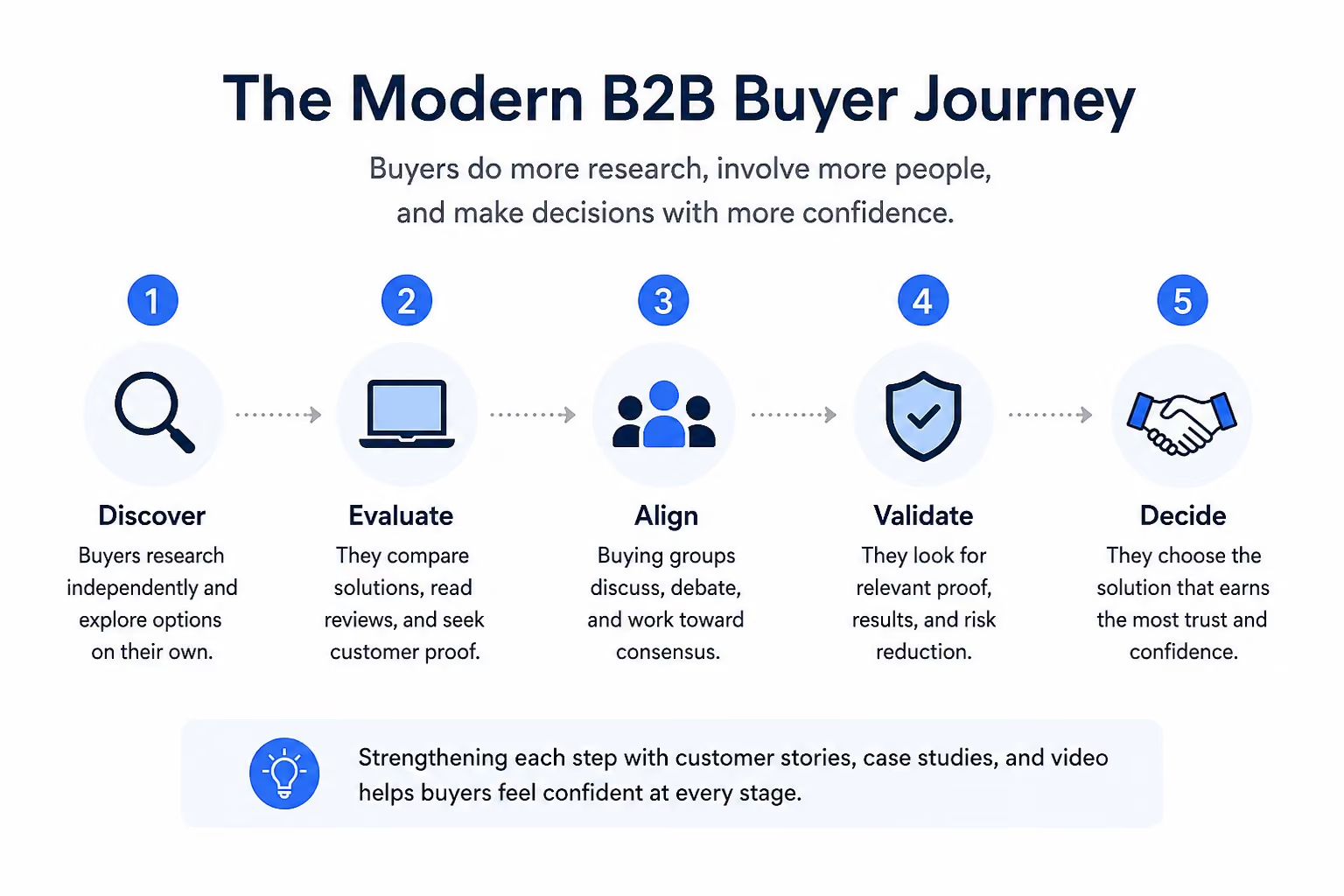
B2B buyers aren’t willing to take a vendor's word for it. They research on their own, compare vendors, use AI tools, involve more stakeholders, and often form a shortlist before they ever talk to sales.
That is where customer proof (like testimonials, case studies, and video social proof) help carry the conversation when your team is not in the room.
Below, we rounded up 47 sourced statistics on B2B buying behavior, trust, testimonials, case studies, customer evidence, and video marketing ROI. Use them to build a business case, support a pitch, or pressure test where customer proof belongs in your content strategy.
At CaseLeap, we produce B2B testimonial and case study videos, so we built this as a practical reference for marketers, sales teams, founders, and revenue leaders who want stronger proof assets across the buyer journey.
For teams actively building customer proof, our page on B2B testimonial videos breaks down the formats, use cases, and production options in more detail.
Methodology
We reviewed recent B2B buying, customer evidence, review trust, testimonial, case study, and video marketing research from Gartner, Forrester, BrightLocal, Demand Gen Report, Madison Logic, UserEvidence, Wyzowl, and Wistia.
Each statistic below is tied to a named source. We prioritized primary research, source-owned reports, and reputable industry publications over recycled stat roundups.
The data is organized into five buckets:
Modern B2B buying behavior
Trust and social proof
Customer evidence and case study performance
Video testimonial and video marketing performance
What the data means for your strategy
How B2B Buyers Actually Buy Now
The buying process has moved away from sales-controlled conversations and toward self-directed research. Buyers are using AI, relying on larger decision groups, and expecting more useful information before they ever speak to a sales rep.
67% of B2B buyers prefer an overall rep-free buying experience. Source: Gartner, 2026. (Gartner)
45% of B2B buyers used AI during a recent purchase. Source: Gartner, 2026. (Gartner)
61% of B2B buyers preferred a rep-free buying experience in Gartner's prior-year survey. Source: Gartner, 2025. (Gartner)
73% of B2B buyers actively avoid suppliers who send irrelevant outreach. Source: Gartner, 2025. (Gartner)
69% of B2B buyers report inconsistencies between information on a vendor's website and what sellers tell them. Source: Gartner, 2025. (Gartner)
74% of B2B buyer teams demonstrate unhealthy conflict during the buying decision process. Source: Gartner, 2025. (Gartner)
Buying groups that reach consensus are 2.5 times more likely to report a high-quality deal. Source: Gartner, 2025. (Gartner)
Content tailored to buying group relevance can positively impact consensus by 20%. Source: Gartner, 2025. (Gartner)
Content focused only on individual-level relevance can have a 59% negative impact on buying group consensus. Source: Gartner, 2025. (Gartner)
The typical B2B buying decision now includes 13 internal stakeholders and nine external influencers. Source: Forrester, 2026. (Forrester)
94% of buyers in groups of six or more report clear benefits from larger buying groups, including broader perspectives, shared validation, stronger budget approval, and greater likelihood of approval. Source: Forrester, 2026. (Forrester)
What this means
If buyers want more control, less irrelevant outreach, and more independent research, then your proof assets need to work before a sales conversation happens.
Testimonials and case studies help buyers answer the questions they are already asking: Who has this worked for? Was the customer like us? What problem did they solve? What result did they get? Can we use this proof to build internal consensus?
Trust and Social Proof Statistics
Trust is harder to earn than it used to be. Generic claims, anonymous reviews, and broad promises are less persuasive when buyers are surrounded by more information and more uncertainty.
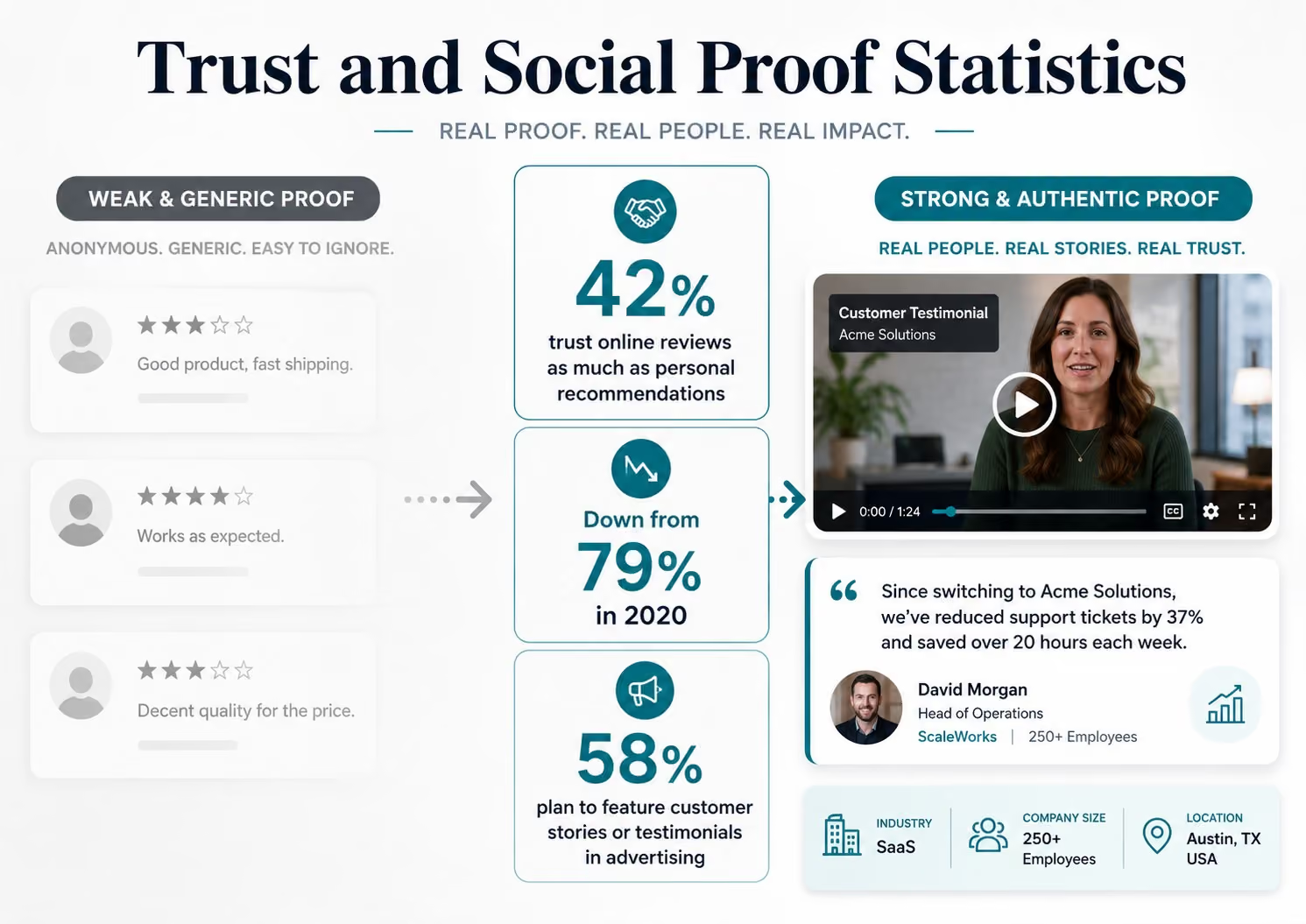
42% of consumers trust online reviews as much as personal recommendations from friends and family, down from 79% in 2020. Source: BrightLocal, 2025. (BrightLocal)
BrightLocal found that trust in reviews has decreased significantly over time, even though consumers still read review details. Source: BrightLocal, 2025. (BrightLocal)
92% of consumers find Google review keyword filters and photos useful in some way. Source: BrightLocal, 2025. (BrightLocal)
Nearly 70% of B2B marketers are looking for innovative ways to drive revenue and measure campaign impact. Source: Demand Gen Report and Madison Logic, 2025. (Demand Gen Report)
B2B marketers' top advertising investment areas for 2025 included social media advertising at 61%, AI tools at 60%, video at 53%, and podcast advertising at 50%. Source: Demand Gen Report and Madison Logic, 2025. (Demand Gen Report)
58% of B2B marketers planned to feature customer stories or testimonials in their advertising. Source: Demand Gen Report and Madison Logic, 2025. (Demand Gen Report)
58% of B2B marketers planned to caption videos and animate advertisements. Source: Demand Gen Report and Madison Logic, 2025. (Demand Gen Report)
Vague or complex messaging was cited as a top advertising dealbreaker by 49% of respondents. Source: Demand Gen Report and Madison Logic, 2025. (Demand Gen Report)
Poor targeting was cited as a dealbreaker by 41%, and ads that do not resonate were cited by 40%. Source: Demand Gen Report and Madison Logic, 2025. (Demand Gen Report)
What this means
Buyers still want proof, but they are more selective about what they trust. A star rating, logo wall, or generic quote may help with surface-level credibility, but it usually does not answer the deeper B2B buying questions.
Specific customer stories are more useful because they give buyers context. They show the problem, the process, the person behind the result, and the reason the outcome mattered.
Customer Evidence and Case Study Performance Statistics
Case studies and testimonials are strongest when they are specific, relevant, and backed by clear evidence. Buyers are not just looking for praise. They are looking for proof that reduces risk.
UserEvidence surveyed B2B buyers, sellers, and marketers to understand which types of customer proof build trust and buyer confidence. Source: UserEvidence, The Evidence Gap. (UserEvidence)
41% of buyers said they start looking in B2B communities, compared with 33% of sellers who believed buyers start there. Source: UserEvidence. (UserEvidence)
57% of sellers believe peer recommendations and word of mouth are the most trustworthy type of customer evidence. Source: UserEvidence. (UserEvidence)
51% of buyers said statistical evidence is one of the most trustworthy customer evidence types. Source: UserEvidence. (UserEvidence)
49% of buyers said case studies or testimonials are one of the most trustworthy customer evidence types. Source: UserEvidence. (UserEvidence)
67% of buyers said a compelling, statistically significant business case around potential ROI is the most important factor when evaluating new software. Source: UserEvidence. (UserEvidence)
61% of buyers said proof of vendor success for similar customers is a top factor when evaluating new software. Source: UserEvidence. (UserEvidence)
Marketers also ranked proof of potential ROI as their top evaluation factor, with 63% selecting it. Source: UserEvidence. (UserEvidence)
Marketers ranked proof of vendor success for similar customers second, with 58% selecting it. Source: UserEvidence. (UserEvidence)
Sellers ranked proof of vendor success for similar customers first, with 71% selecting it. Source: UserEvidence. (UserEvidence)
Sellers ranked proof of potential ROI second, with 65% selecting it. Source: UserEvidence. (UserEvidence)
UserEvidence found that buyers want customer evidence that is specific and relevant to their situation. Source: UserEvidence. (UserEvidence)
Customer logos on a homepage came in last among the customer evidence factors discussed in the UserEvidence report, at 30%. Source: UserEvidence. (UserEvidence)
Buyers want quantitative proof that a solution can do what the vendor claims. Source: UserEvidence. (UserEvidence)
Buyers also want tailored business cases that give them confidence the solution will meet their needs. Source: UserEvidence. (UserEvidence)
What this means
The best case studies are not built around the biggest logo. They are built around the clearest relevance.
A buyer wants to see a company like theirs, with a problem like theirs, getting a result they can imagine defending internally. That is why strong case studies need more than a happy quote. They need context, customer voice, measurable outcomes, and a clear connection to the buyer's real situation.
Video adds trust signals that written proof cannot always deliver. Face, voice, tone, and emotion help buyers evaluate whether the customer story feels credible.
63% of video marketers say they have used AI video tools to help create or edit marketing videos. Source: Wyzowl, 2026. (Wyzowl)
51% of video marketers had used AI to create video the year before, showing a meaningful year-over-year increase. Source: Wyzowl, 2026. (Wyzowl)
92% of marketers planned to spend the same or more on video marketing in 2026. Source: Wyzowl, 2026. (Wyzowl)
41% of marketers had spent money on video ads, up from 36% the year before. Source: Wyzowl, 2026. (Wyzowl)
82% of marketers said video marketing gave them a good ROI. Source: Wyzowl, 2026. (Wyzowl)
67% of video marketers quantify ROI through video views. Source: Wyzowl, 2026. (Wyzowl)
63% of video marketers quantify ROI through engagement such as likes, shares, and reposts. Source: Wyzowl, 2026. (Wyzowl)
52% of video marketers quantify ROI through leads and clicks. Source: Wyzowl, 2026. (Wyzowl)
93% of video marketers said video helped increase user understanding of their product or service. Source: Wyzowl, 2026. (Wyzowl)
85% of video marketers said video helped generate leads. Source: Wyzowl, 2026. (Wyzowl)
82% of video marketers said video helped keep visitors on their website longer. Source: Wyzowl, 2026. (Wyzowl)
Videos under one minute average a 52% engagement rate, and customer testimonial videos under one minute average 46% engagement. Source: Wistia, 2025. (Wistia)
What this means
The case for video testimonials and case study videos is practical, not just emotional.
Video can help explain complex products, increase time on page, support sales conversations, create reusable clips, and give internal champions something persuasive to share with the rest of the buying group.
If you are budgeting for this type of asset, our video testimonial cost guide explains what affects pricing, from remote interviews to on-site production and edited cutdowns.
For B2B teams, that matters because the buyer is rarely one person. A strong customer story gives your champion a proof asset they can pass around internally.
What the Data Means for Your Strategy
A few clear conclusions come out of these 47 statistics.
1. Buyers decide before they talk to you
B2B buyers are using AI, researching independently, and showing a clear preference for more control over the buying process.
That means your proof has to do more work on its own. Case studies and testimonials help buyers understand what you do, who you help, and what kind of outcomes are realistic before they ever reach out.
2. Buying groups need alignment, not just information
Gartner's data shows that buying teams often experience unhealthy conflict, and that consensus is tied to better deal quality. That means your content should not only persuade one person. It should help the group agree.
Case studies and testimonials can support that process by giving every stakeholder the same clear story: the problem, the solution, the customer experience, and the outcome.
3. Relevance beats prestige
A recognizable customer logo can help, but relevance is what makes a story useful.
Buyers want to see customer evidence that maps to their industry, company size, use case, role, risk, and expected outcome. A famous logo with a vague quote is usually less useful than a specific story from a company that looks like the buyer.
4. Specific stories beat generic reviews
Trust in anonymous reviews has declined sharply, and buyers are looking for more objective ways to evaluate vendors.
Written reviews still support discovery and baseline credibility. But named customers, direct quotes, measurable results, and on-camera stories provide deeper proof.
5. Video raises the credibility ceiling
Video adds authenticity signals that written proof cannot always deliver. Buyers can hear the customer's voice, read their expression, and understand the story faster.
That makes video especially useful on landing pages, product pages, sales follow-ups, email nurture sequences, paid campaigns, and stakeholder-facing sales decks.
6. One customer story can support multiple touchpoints
A single customer interview can become more than one asset. With the right planning, one story can produce:
A full video case study
A shorter testimonial cut
Social clips
Pull quotes
Sales enablement snippets
Landing page proof sections
Blog or written case study content
Email nurture assets
Paid ad creative
Internal sales training examples
That is why the production plan matters. The best testimonial and case study videos are not just filmed. They are designed to become reusable proof across the funnel.
This is also where a strategy-first production approach helps. Planning the story, interview, edit structure, and cutdowns upfront makes it easier to turn one customer story into a full proof system.
How to Use These Statistics
These numbers are useful, but they should not sit in a slide deck forever. Use them to make better decisions about where customer proof belongs.
Use them to justify budget
If your team needs buy-in for testimonials, case studies, or video production, the buyer behavior data makes the business case. Buyers are self-educating, comparing vendors earlier, using AI tools, and involving more people in the decision.
Use them to audit your current proof
Look at your website and sales process. Do buyers see customers who look like them? Do your stories include the problem, solution, and outcome? Do they answer real objections?
If not, you may not have a proof volume problem. You may have a proof relevance problem.
Use them to prioritize the right stories
Start with the segments that matter most to revenue. That might mean one story per key vertical, one story per major use case, or one story for each common sales objection.
Use them to repurpose smarter
Since buyers consume information across multiple channels and stakeholders, do not treat a customer story as a one-time asset. Turn it into a content system.
Put These Numbers to Work
Statistics make the case. Customer stories make it believable.
CaseLeap produces B2B testimonial video services, on-site or fully remote, built around the proof buyers actually look for: relevant customers, specific problems, clear outcomes, and credible stories.
Why are testimonials and case studies so effective in B2B?
Testimonials and case studies work because most of the buying decision happens before a buyer talks to sales. Buyers research independently, compare vendors, use AI tools, and look for proof that a solution has worked for companies like theirs.
A good customer story helps answer the questions your sales team may not be present to hear: Is this relevant to our industry? Can this solve our specific problem? What kind of result is realistic? Who else has trusted this company before us?
What is the difference between a testimonial and a case study?
A testimonial is usually a shorter endorsement focused on the customer's experience, satisfaction, or result. It often works well on landing pages, homepages, paid ads, social media, and sales follow-ups.
A case study is a more structured story. It typically covers the problem, why the customer chose the solution, how the process worked, and what outcome they achieved. Case studies are especially useful in the consideration stage, when buyers are comparing vendors and trying to reduce risk.
Most B2B teams benefit from both.
Do video testimonials actually increase conversion rates?
Video testimonials can support conversion because they make customer proof easier to trust, understand, and remember. They give buyers more than a quote. They show the person behind the story.
The exact lift depends on the audience, offer, page layout, placement, story quality, and relevance of the customer featured. The safest takeaway is that relevant customer proof on a decision page usually helps reduce hesitation and improve buyer confidence.
How many case studies does a B2B company need?
There is no fixed number. The better question is whether your case study library reflects the buyers you are trying to win.
A few highly relevant case studies are usually more useful than a large library of generic ones. Start by covering your most important verticals, highest-value use cases, most common sales objections, and strongest measurable outcomes.
Are written reviews still worth collecting?
Yes. Written reviews can still support discovery, reputation, and baseline credibility. They are especially useful on third-party platforms where buyers are already comparing vendors.
But written reviews usually cannot carry the full story on their own. For high-consideration B2B purchases, named customer stories, direct quotes, measurable outcomes, and video testimonials can provide the deeper proof buyers need.
Where should I place testimonial and case study content?
Put customer proof wherever buyers research, compare, and make decisions. That usually includes:
Homepages
Product or service pages
Landing pages
Pricing pages
Sales follow-up emails
Proposal decks
Paid ad campaigns
Retargeting campaigns
Social media
Email nurture sequences
Sales enablement libraries
Since buyers often consume several types of content before making a decision, one strong customer story should be repurposed across multiple touchpoints.
You can also review testimonial and case study video examples to see how different story formats work across landing pages, sales enablement, social, and nurture campaigns.
What makes a B2B testimonial or case study credible?
The strongest customer stories are specific, relevant, and easy to verify. They usually include:
A named customer or clearly identified company type
A specific problem
A clear reason the customer chose the solution
Direct customer quotes
Measurable or observable outcomes
Details that match the buyer's industry, role, or situation
A story structure that feels natural instead of scripted
The goal is not to make the customer sound perfect. The goal is to make the story believable.
Should customer proof be industry-specific?
Yes, whenever possible. Buyers want to see proof that feels relevant to their situation. Industry, company size, use case, buyer role, and problem solved all help make a customer story more persuasive.
That does not mean every case study has to be hyper-niche. But your highest-priority segments should have proof assets that feel directly relevant to them.
Can one customer story become multiple assets?
Yes. One strong customer interview can often become a full case study video, a short testimonial, social clips, written quotes, a blog-style case study, sales deck proof, and paid ad creative.
The key is planning for repurposing before the interview happens. If the production is structured correctly, you can capture the full story and the short proof points in one process.
Build trust and accelerate conversions
Contact us today. We'd love to help you supercharge your sales conversions.