Get a Video Gap Analysis for your company · See which videos could have the biggest pipeline impact
See Where Your Competitors Are Winning With Video Get a custom Video Gap Analysis for your company · See which videos could have the biggest pipeline impact
Thanks - our team will review your website and put together your personalized Video Gap Report. Expect it atthe email address you provided within 2 business days.
We'll put together a personalized report showing where video could have the biggest impact, how your competitors are using it, and specific opportunities for your team. You'll get strategic recommendations, not generic advice.
Thank you! Your submission has been received!
Oops! Something went wrong while submitting the form.
6 B2B Video Testimonial Examples That Drive Real Pipeline
Build trust, reduce buyer friction, and help sales teams close deals faster
May 28, 2026
Most B2B video testimonial examples look good on a website. Far fewer help a buyer say yes faster.
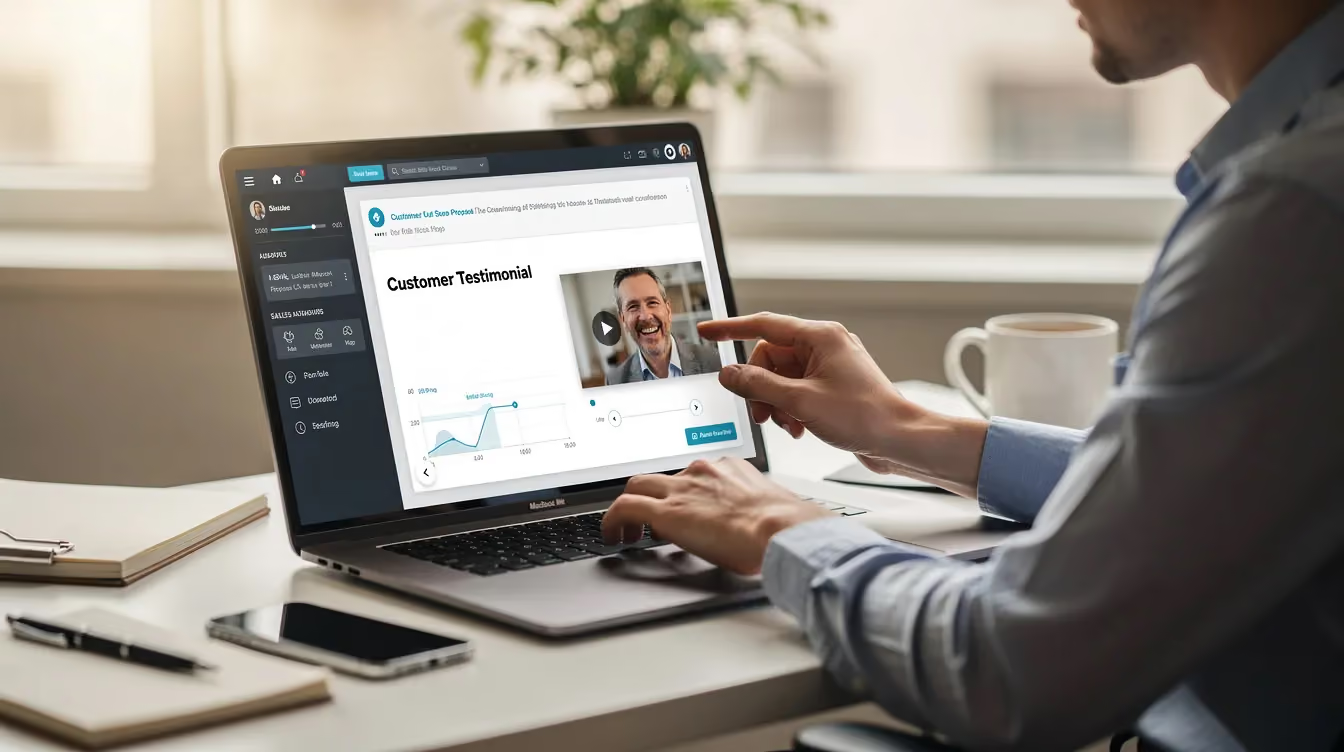
That is the gap this article is built around. Testimonial videos are a powerful form of social proof that can significantly influence potential buyers by showcasing real customer experiences and outcomes. But in B2B, the best video testimonials do more than create a positive impression. They reduce decision risk, give champions proof to share internally, and help the sales team move deals forward.
Below, we will break down what separates a strong testimonial video from generic praise, study the best testimonial video examples worth learning from, and show how to plan client testimonial videos your reps will actually use.
Why Most B2B Video Testimonials Sound Good But Do Nothing for Pipeline
The problem is not the camera. It is the script.
Most customer testimonial videos are built around compliments. "The team was amazing." "We loved working with them." That kind of praise feels good to hear but gives a prospective buyer nothing to work with.
B2B buying involves a committee. Marketing, finance, IT, and operations all have to agree. Each person wants different proof. A vague success story does not give any of them a reason to say yes.
The strongest b2b video testimonials answer real business questions. What was the pain point? What did it cost the company? What changed after implementation? What measurable outcomes can a champion bring back to leadership?
That is what separates a great testimonial video that shortens a sales cycle from one that just collects views.
What Makes a B2B Video Testimonial Actually Work
Before the examples, here is the framework. Every strong b2b testimonial has four things.
A named business problem Not "we had inefficiencies." Something specific. "Our support team was manually routing tickets across six regions and first-response times were slipping." That specificity makes prospective customers see themselves in the story.
A speaker who matches the buyer persona The speaker matters as much as the story. An executive validates ROI and risk reduction. A real user explains adoption and day-to-day workflow change. The best client testimonial videos often capture both because the buying committee includes both.
A specific, verifiable outcome Numbers build trust. A 40% shorter sales cycle. 12 hours saved per week. $125K increase in average deal size. If the customer cannot share hard numbers, use timeline, behavior change, or adoption rate instead.
A narrative arc buyers can map onto their own situation Problem. Solution. Result. That structure is simple because it works. It gives potential customers a clear path from where they are now to where they want to be.
Get these four elements right and the video does real work across the sales funnel, not just on the homepage.
6 B2B Video Testimonial Examples Worth Studying
These b2b video testimonial examples are not here because they look impressive. They are here because they show how format, speaker choice, and story structure create real business impact.
CaseLeap On-Site Testimonial: Credibility Through Context
Format: On-site customer success story
Best for: Enterprise, healthcare tech, financial services, manufacturing
Where it works: Case study pages, proposals, sales decks, high-intent landing pages
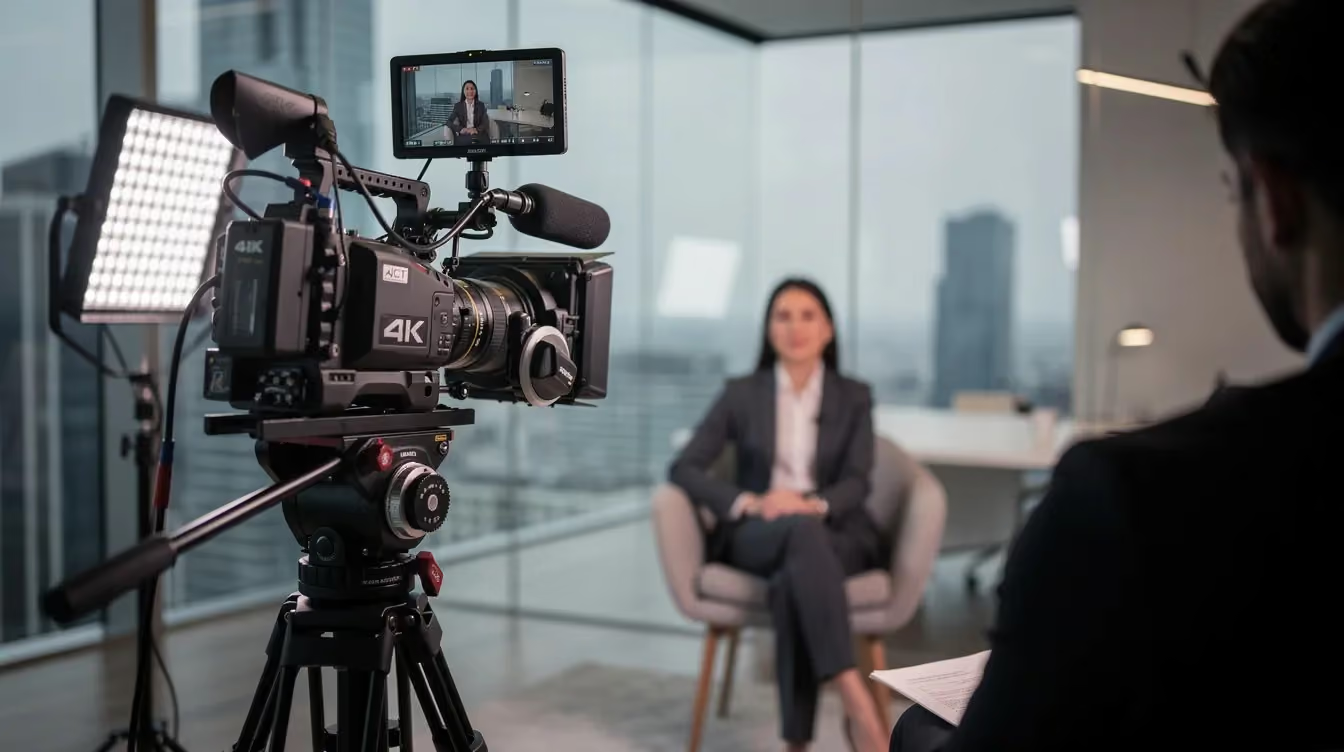
On-site production works because the environment becomes part of the proof. The camera is not limited to a talking head. It can show the office, the team, the product in use, and the behind the scenes details that make the story feel grounded.
A strong on-site b2b testimonial opens with a specific industry challenge, then uses contextual B-roll footage to visually support what the speaker is saying. Multiple camera angles, clean lighting, and real workplace footage all reinforce credibility without losing authenticity.
Steal this: Film at the client's location when the environment adds to the story. On-site production signals investment and makes the customer experience feel real.
CaseLeap On-Site Testimonial: Speed Without Losing Trust
Format: On-site customer interview
Best for: Financial services, private equity, consulting, SaaS, professional services
Where it works: Product pages, sales enablement, nurture campaigns, proposal follow-up
In this example, BluePoint Capital Partner John Lame explains how Stout became a long-term advisory partner across more than 50 engagements over a 20-year relationship.
What makes this testimonial effective is the specificity. Instead of broad praise, the speaker explains exactly why the relationship works: fast execution under tight timelines, understanding the risk profile of transactions, and the ability to think like investors during due diligence.
The result feels less like a scripted endorsement and more like a real business conversation between experienced operators. That level of detail builds credibility with prospective buyers evaluating high-trust professional services.
Steal this: Strong client testimonials focus on operational value and decision-making support, not just customer satisfaction. Specific examples of speed, expertise, and business impact create far more persuasive social proof.
Zendesk: Multi-Customer Compilation for Broad Proof
Format: Multi-customer compilation
Best for: Broad ICPs, testimonial pages, event screens, retargeting
Where it works: Homepage, investor decks, awareness campaigns
A compilation lets multiple customers reinforce one message. Zendesk uses this format across their customer stories, bringing in different industries, company sizes, and roles to show that their solution works across the board.
The advantage is coverage. One real customer speaks to one segment. Multiple customers speak to several at once. It also removes the feeling that your best case study is cherry-picked.
Steal this: Use a compilation when your marketing strategy needs one video asset that supports multiple buyer personas without producing multiple videos.
Dropbox Business: The Product and Testimonial Hybrid
Format: Product demo plus testimonial
Best for: Consideration stage, SaaS product pages, comparison pages
Where it works: Product pages, demo follow-up emails, onboarding sequences
Dropbox Business shows how a hybrid format handles the most common mid-funnel question: will this actually work for us?
Most SaaS testimonial videos fail because buyers never see the product in a real workflow. A product demo alone can feel controlled. The hybrid puts both together. A real customer walks through actual product usage while narrating their outcome. Screen recordings and customer narration show workflow fit in a way that a feature overview never could.
Steal this: Use screen recordings and customer narration together when your buyer needs to see the product in context before booking a demo.
GLEAN and Gainsight: Full Narrative for Late-Stage Buyers
Format: Long-form customer success story (2 to 5 minutes)
Best for: Complex buying process, high ACV, late-stage evaluation
Where it works: Proposals, case study hubs, sales decks, demo follow-up
Lauren Kennedy, Head of Customer Success at GLEAN, shares what changed after her team implemented Gainsight Essentials. The video covers the before state, why the team needed a structured approach to customer success, and what the impact looked like after adoption.
That level of detail is not for someone scrolling LinkedIn. It is for a buyer who is already serious and needs more than a highlight reel. A VP of Customer Success evaluating a platform wants to hear from someone in their role explaining a real implementation, not a brand summarizing results in a voiceover.
The speaker choice matters here too. A Head of Customer Success talking to other customer success leaders is far more persuasive than a polished brand narrator. The credibility comes from the role, the specificity, and the fact that it is an unscripted on-camera conversation.
Steal this: Long-form videos are not a liability at the decision stage. Pair one with a written case study when your buyer needs both emotional proof and internal documentation to bring back to the buying committee.
UiPath: Lead With the Number
Format: Data-driven testimonial with hard metrics
Best for: Operations, finance, IT, enterprise software buyers
Where it works: ROI pages, CFO-facing follow-up, executive sales decks
MAS Holdings used UiPath to automate key operations across their manufacturing business. The result was 2,500 man-days of savings while hitting on-time delivery targets and maintaining the accuracy standards their production teams required.
That metric leads the story. For an analytical buyer in operations or finance, a number in the first ten seconds gives them a reason to keep watching. It also gives the internal champion something specific to bring back to leadership when building the business case.
Steal this: If your product has measurable ROI, put the number first. Do not bury time saved, cost reduced, or accuracy gains at the end of a two-minute video.
The 5 B2B Video Testimonial Formats and When Each One Converts
The best testimonial videos are not one-size-fits-all assets. Format should match funnel stage, buyer intent, and where the video actually lives.
Short clips, 15 to 45 seconds
Best for homepage trust signals, paid social, cold outreach, and quick sales follow-up.
One pain point, one speaker, one outcome. These are proof points, not full stories. The goal is to give prospective customers a reason to keep engaging, not to tell the whole story in one shot.
Mid-length objection handlers, 45 to 90 seconds
Best for product pages, landing pages, email campaigns, and retargeting.
This is the sweet spot for most B2B use cases. There is enough room for problem, solution, and result without losing the viewer. Use this format to address specific objections around implementation, switching cost, or ROI.
Long-form customer stories, 2 to 5 minutes
Best for late-stage sales decks, proposals, case study pages, and demo follow-up.
These give buyers the detail they need when they are already serious. A real customer walking through the full customer journey can answer questions a sales rep would otherwise need three follow-up emails to cover.
Multi-customer compilations
Best for testimonial pages, event screens, investor decks, and broad awareness campaigns.
Compilations work when your target market spans multiple verticals or company sizes. Each clip adds another layer of social proof and the combined effect builds brand identity and trust across multiple buyer segments at once.
Feature-specific spotlights
Best for SaaS pricing pages, comparison pages, and onboarding sequences.
These are built for consideration. A real user explains one specific feature in context, ideally through screen recordings or their own words, so the prospective buyer sees business value rather than just an interface.
How to Plan a B2B Testimonial Video Your Sales Team Will Actually Use
Pick the right customer
The best candidates are not always the happiest customers. They are the customers whose story matches your target market.
Look for someone who can explain the original problem, what it was costing the business, what alternatives they considered, and what changed after implementation. Depth of story matters more than size of logo.
Also consider whether the speaker can be natural on camera. Authentic storytelling depends on real stories told in the speaker's own words, not a memorized script.
Learn more about securing customer testimonials in our detailed guide.
Ask questions that pull out specifics
Generic questions produce generic answers. Ask questions that force specificity.
What was happening before you found us? What was that problem costing the company? What did your team need to see before saying yes? What changed in the first 30, 60, or 90 days? What metric best represents the improvement?
That structure gives you the raw material for a strong edit without scripting every word.
Choose between on-site and remote production
Use on-site when the location adds to the story. Offices, facilities, clinics, and factories can add visual credibility that a talking head cannot.
Use remote when speed, geography, or budget is the priority. A well-run remote session with clean audio and good framing can produce engaging videos that work just as hard as on-site content.
Do not script every word. Give the speaker talking points and let the conversation breathe.
The best moments in any customer interview come from raw honesty. The unexpected detail. The genuine frustration with the old way. The simple explanation of why things finally clicked. Strong production quality supports that authenticity. It should never replace it.
Repurpose before you publish
Plan the deliverables before the shoot, not after.
One customer interview can become a full success story, short clips for LinkedIn, a homepage proof point, a product page video, a sales email asset, a proposal insert, a quote card, and a written case study.
That is how a single shoot becomes a content system across the entire sales funnel.
Make it easy for sales reps to find and use what you create. Label assets by industry, persona, pain point, and outcome. If a rep cannot find the right clip in 30 seconds, they will not use it.
Final Thought
The best b2b video testimonial examples all have the same foundation. A real customer, a specific problem, a clear result, and a format matched to where the buyer actually is in the decision process.
If your current customer testimonial videos are too vague for sales or missing the measurable outcomes that move a buying committee forward, the fix starts with better story strategy and choosing the right production partner.
CaseLeap helps B2B teams capture, produce, and activate testimonial videos that your sales team will actually use. Talk to the CaseLeap team to get started.
FAQs
What makes a B2B video testimonial different from a B2C one?
A B2B video testimonial differs from a B2C one because it has to support a buying committee, not just a single person. B2B buyers involve multiple roles across finance, IT, operations, and leadership. Each person needs different proof. That means the speaker, the metric, and the narrative all need to address business outcomes like ROI, implementation confidence, and risk reduction, not just personal satisfaction or emotional appeal.
How long should a B2B testimonial video be?
A B2B testimonial video should be 45 to 90 seconds for most product pages and email campaigns, 15 to 45 seconds for social and outbound, and 2 to 5 minutes for late-stage proposals and sales decks. The right length depends on the funnel stage and where the video lives. A buyer evaluating a platform in a proposal has stronger intent than someone scrolling LinkedIn. Format should follow context, not habit.
What questions should you ask in a B2B testimonial interview?
The best B2B testimonial interview questions focus on the before state, the decision process, and measurable outcomes. Ask: what was the problem and what was it costing the business? What made you start looking for a solution? What did your team need to see before saying yes? What changed in the first 30, 60, or 90 days? Which metric best proves the improvement? These questions produce specific, usable answers without scripting every word.
Do you need professional production for B2B video testimonials?
Professional production is recommended for B2B testimonial videos used in sales decks, executive presentations, or high-value landing pages. For those use cases, clean audio, strong framing, and polished editing remove friction and reinforce credibility. For social clips or internal enablement, a well-run remote session with good lighting can work just as well. The format should match the context.
Where should B2B video testimonials be used in the sales funnel?
B2B video testimonials should be used at every stage where decision friction appears. Short clips work on homepages, social media, and cold outreach. Objection-focused videos belong on product pages, landing pages, and nurture emails. Long-form customer stories belong in proposals, demo follow-ups, and sales decks. Compilations work well on testimonial pages and in retargeting campaigns. The most common mistake is producing one video and placing it in one place. A single customer interview can fuel assets across the entire funnel if deliverables are planned before the shoot.
Build trust and accelerate conversions
Contact us today. We'd love to help you supercharge your sales conversions.